




In Lewis Carroll’s 1865 novel, Alice’s Adventures in Wonderland, Alice unwittingly falls into a rabbit hole, which leads to a fantastical place called Wonderland. It’s one of the defining works of literary nonsense and has gone on to inspire countless forms of media, from Pan’s Labyrinth to Spirited Away.
Watching Serial Experiments Lain is a lot like falling into Alice’s rabbit hole. The 13-episode psychological anime is an irresistible blend of mystery, horror, and pre-2000s internet culture. It’s a vestige of a long-lost era, rolled into one of the most bingeable shows in the medium.
Serial Experiments Lain also bears several similarities with Carroll’s classic, but it isn’t for the faint of heart. Despite being a cyberpunk masterpiece, it’s not quite Blade Runner or Cyberpunk: Edgerunners. It’s universally described as a “difficult” sci-fi show, largely due to its slow and quiet storytelling. Much like Sonny Boy, Serial Experiments Lain is a sensory overload, but it’s mostly fueled by the radical, almost religious hope of early internet culture rooted in the show’s version of Web 1.0, a techno-spiritual frontier called the “Wired.”
Lain centers on an introverted, tech-averse fourteen-year-old named Lain Iwakura, whose emotionally detached suburban household feels like a suffocating purgatory. Lain’s quiet routine is shattered when she and her classmates begin receiving emails from fellow student Chisa Yomoda, who — despite having committed suicide days prior — claims she has abandoned her physical body to exist within the Wired. Drawn into the mystery, Lain convinces her father to upgrade her PC, called a “NAVI,” and takes her first tentative steps into the sprawling digital network of the online world.
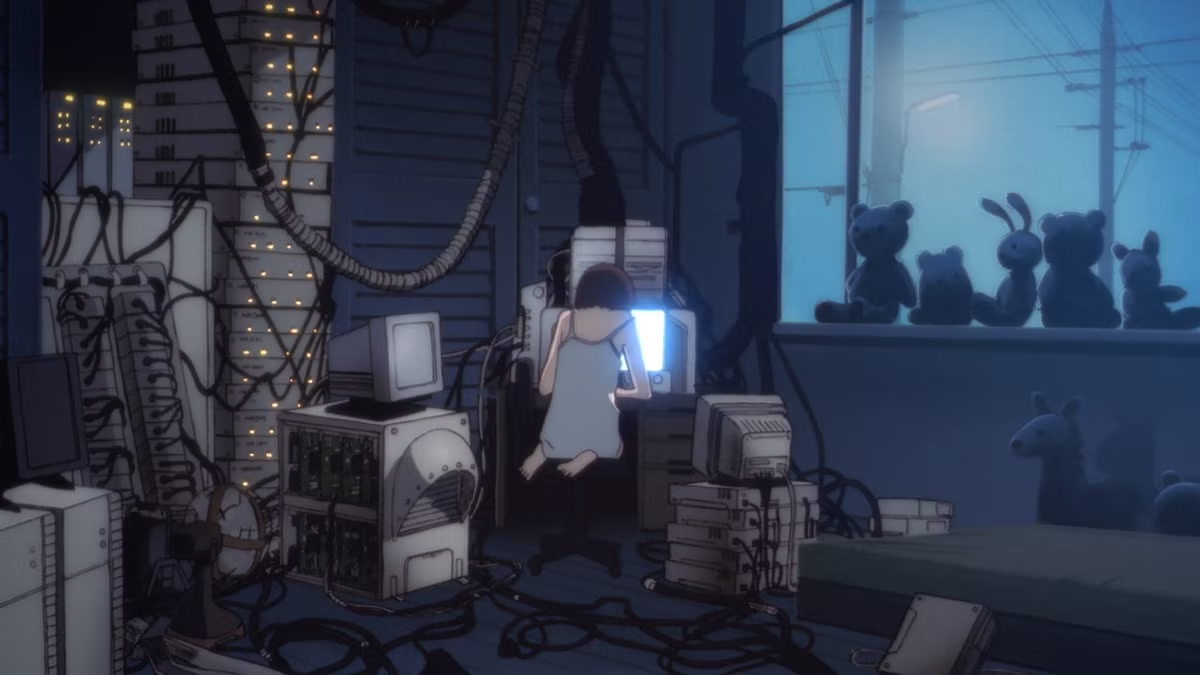
What starts as curiosity soon spirals into obsession. The deeper Lain ventures into the Wired, the more the boundary between person and machine erodes. Additional NAVI upgrades start to fuse with Lain’s physical body in a mass of tangled cables and glowing computer screens. She is soon thrust into a conspiracy involving the Knights of the Eastern Calculus, a shadowy hacker group that wants to destroy the barrier between the unconscious human mind and the Wired. Meanwhile, a second Lain emerges online, one that is far more dangerous and volatile than the timid girl sitting behind the screen.

Serial Experiments Lain is the result of a nearly unprecedented collision in anime talent. Renowned character designer and graphic artist Yoshitoshi Abe (Texhnolyze, Haibane Renmei) gifted the series its iconic visual language of haunting stillness. Writer Chiaki J. Konaka used his fascination with networks and identity to imbue the series with one of the most original interpretations of the online experience. Director Ryūtarō Nakamura shaped Lain into what feels like a psychological drift through unsettling stretches of emptiness, long silences, and minimal narrative motion. Composer Kow Otani (Mobile Suit Gundam Wing, Shadow of the Colossus) reinforced these themes with a sparse ambient soundtrack. Lain is this rare convergence of like-minded creators all fascinated by the same philosophical obsessions.
When Lain first premiered on TV Tokyo in 1998, the week-to-week experience gave viewers time to sit with each episode, discuss it, theorize, and attempt to decode all of its symbols, which encouraged a puzzle-solving mindset. But in 2026, watching all 13 episodes in one go creates a very different effect. The repetitions, ambient sounds, visual motifs, psychological unraveling, and reality glitches stack together to create this dream-like experience, mostly made manifest through the Wired.
On a surface level, the Wired serves as the show’s version of the real-world internet, but it’s weirder than that — stranger even than Alice’s Wonderland. Unlike the structured digital cyberspaces in other anime like Summer Wars, Den-noh Coil, or Ghost in the Shell, the Wired is left intentionally vague and rarely portrayed visually. It’s first recognized as a global communications system and gradually evolves into something more metaphysical and much harder to explain. It’s sort of like an uncanny ecosystem of information that diminishes individual human consciousness as more minds connect to it.
Although its digital landscape is rarely ever shown in a visual sense, the Wired still looms in the background of nearly every shot, represented as power lines and utility poles, tangled cables and NAVI hardware, flickering scenes, the constant hum of computer screens, digital artifacts, and sudden cuts. Rather than showing cyberspace directly, Lain opts instead to show reality breaking under its influence. Lain says it herself: “No matter where you are, everyone is always connected.”
The Wired is what makes Lain such a fascinating thought experiment. The series begins with a seemingly benign question: What if the online world is better than the real one? As the series progresses, that question changes into something far more disturbing, and one more relevant than ever, as our daily lives are spent online nearly every waking moment. Instead of arguing that the Wired is superior to reality, Lain wonders whether the distinction between the two was ever meaningful in the first place. In other words, at what point does the digital world stop being an escape from reality and start becoming reality itself?
Lain is no Alice, but she experiences her own descent into a digital Wonderland that fundamentally changes her. And with only 13 episodes, you can follow her down that digital rabbit hole into the Wired yourself in a single sitting. Who knows? You may find it harder to leave than you expect.
Serial Experiments Lain is available to stream on Apple TV and the Internet Archive.