




Disney’s original 2016 animated movie Moana is a powerful fable about identity. The theme runs through every character arc, with the protagonist Moana (Auli’i Cravalho), her reluctant demigod ally Maui (Dwayne Johnson), and monstrous antagonist Te Kā (no voice credit) all suffering from various identity crises that need to be resolved. Every one of Lin-Manuel Miranda’s powerful songs incorporates the idea of characters defining themselves: All of them have lyrics built around some variation of “Who am I?”, “Here’s who I am,” “We know who we are,” or “You know who you really are.”
So it’s odd to see Disney’s 2026 live-action version parroting that theme while lacking any identity of its own. Virtually every line, beat, and song in the new movie is identical to the 2016 version, apart from a few minor punch-ups or extra comedy tags here and there. At this point, there’s no question why Disney keeps green-lighting these live-action remakes: nearly all of them make huge piles of money. But there’s no artistic or aesthetic reason for the live-action Moana to exist. The best of Disney’s live-action rewrites add some sort of new spin or distinctive conceptual voice into the mix. The 2026 Moana is just a glossy digital clone of the original.
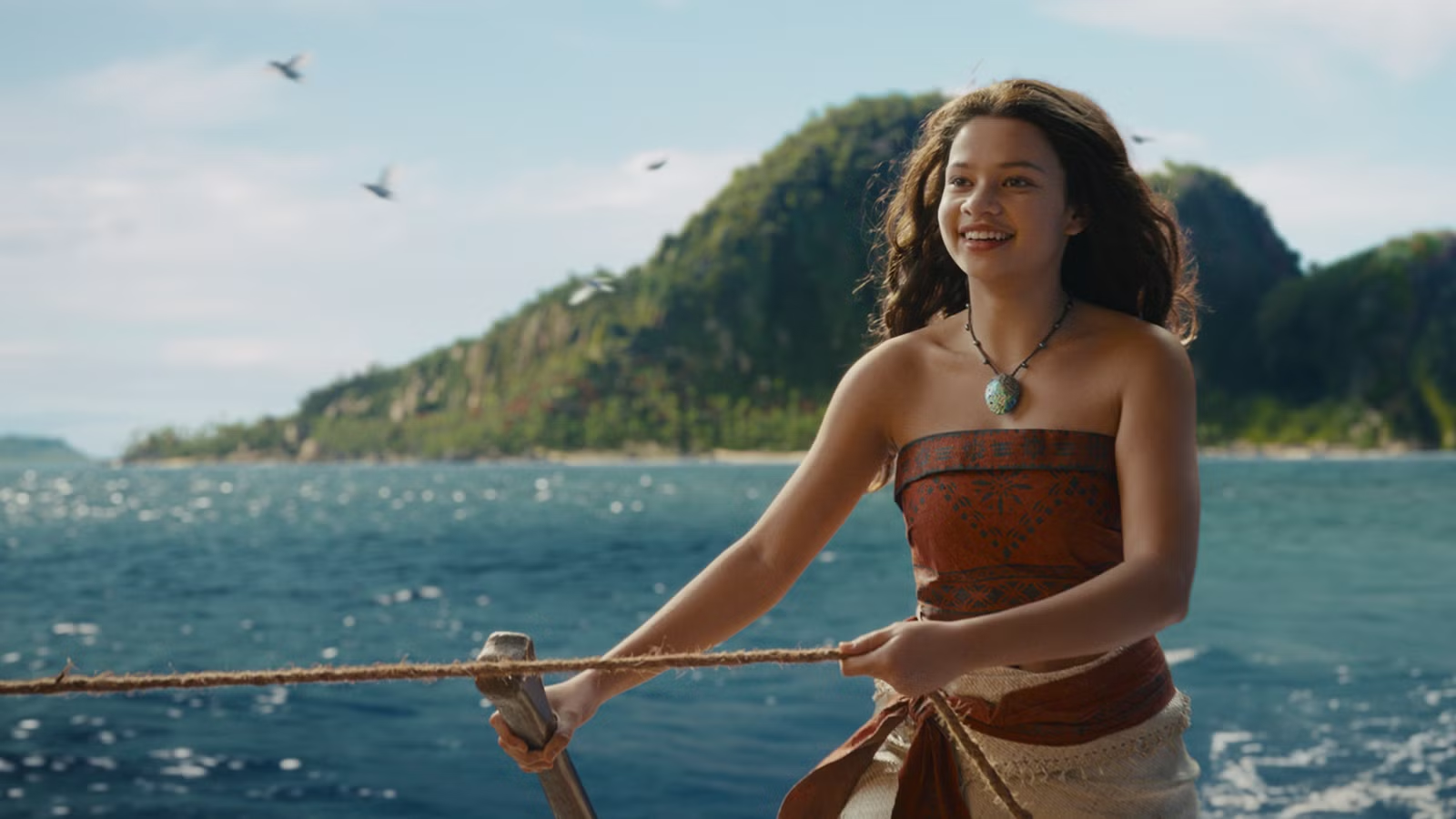
Once again, Polynesian princess (not a princess, but still obviously a princess) Moana, now played by newcomer Catherine Laga’aia, chafes at the restrictions her well-meaning parents (John Tui and Frankie Adams) have put on her. Moana loves the sea (her name is the Māori word for “ocean”) and longs to sail away from the paradisiacal island of Motunui, where she’s expected to succeed her father as chieftain. Chief Tui has forbidden anyone to leave Motunui, but Moana has to defy that rule when the island begins to die. The demigod Maui (Johnson again) has stolen the heart of the “mother island” goddess Te Fiti, letting a poisonous rot into the world. Moana has to leave her island, learn to sail, find Maui, bring him the heart, convince him to be a hero, and restore Te Fiti in order to save her people.

That story returns beat-for-beat in the live-action movie, with minimal changes. Johnson gets a few new lines as Maui, the rakish, narcissistic shapeshifting demigod, and fan-favorite dumb chicken Heihei gets a few more visual gags. (Alan Tudyk voiced him in the original; this time out, he doesn’t have a voice credit.) It isn’t quite a shot-for-shot remake: comparing any given scene, it’s clear that the angles and visual focus vary. Director Thomas Kail (who helmed Disney’s live-on-Broadway Hamilton movie) makes more time for Polynesian dance in particular, with Laga’aia, her parents, and a large cast of extras adding synchronized movement to their village rituals.
There are inherent differences here, particularly in Maui. The animated version is more cartoonish than most of the other characters, with improbably square dimensions and a smooth, timeless, presumably immortal face. Johnson is 54 years old, and while he wears it well, he’s a craggier, more obviously worn and weary version of the character. He’s still cartoonish, both in his glib, outsized personality and in his outsized body, achieved with 40 pounds of muscle-enhancing prosthetics. Just as in the original movie, his tattoos are animated, with a little mini-me version of himself on his left pectoral adding constant comic punctuation to scenes. But Maui still seems more human in this movie.
Kail and the screenwriters (returning writer Jared Bush and Moana 2’s Dana Ledoux Miller) correspondingly tone down Maui’s goofy physical comedy a tad, and give him more gravity. He still gets a CG shark head when his shapeshifting powers go awry, for instance, but doesn’t deliberately return to that form for a lighthearted chuckle in the final battle with Te Kā.

Similarly, there’s an obvious difference in setting the movie in a real, physical world — though in this case, it matters considerably less than in a movie like Disney’s live-action Beauty and the Beast or Cinderella. While the film was shot in Hawaii, and some significant percentage of the environment is presumably authentic, there are so many digital characters, effects, and settings that the whole movie has a slick digital gloss, and nothing looks particularly “real.” Heihei and Moana’s pet pig Pua are virtually identical to their animated-movie counterparts, apart from more shading and shadows, and the giant singing crab Tamatoa (again voiced by Jemaine Clement) comes with more visual detail but the same basic digital design. Everything here looks expensive, but almost nothing has meaningful, physical weight.
The one exception is the background cast, the Motunui villagers, who come with a level of specificity and individuality that’s unique to human actors. In this version, they vary more widely in body type and facial shape, in all the little details that make up humanity. They don’t have any more significant role to play — they’re effectively elaborate human set dressing. But there’s still a difference between seeing animated generalizations of brown-skinned people, and seeing real ones celebrated on screen for their physical diversity, athletic ability, distinctive cultural heritage, and community.
Laga’aia herself is an impressive screen presence. She isn’t always the most natural actor — some scenes in the live-action movie play as if all the performers are reading aloud from billboards. The animated character’s easy smile sometimes looks forced and artificial on a real face. But Laga’aia’s vocal performance and physicality are convincing in the role, particularly in the frequent moments when she’s asked to embody defiance and a stubborn, strong will.
And Miranda’s songs retain their power. The one new song he wrote for the movie is forgettable — “Along the Way,” which comes complete with Johnson rapping once again, only plays over the closing credits. It’s also surprisingly reminiscent of the equally forgettable Moana 2 songs. But “We Know The Way” still packs a powerful emotional punch. Moana’s songs of yearning, self-questioning, and ultimately revelation are as satisfying as they ever were. “You’re Welcome,” once again a visually goofy breakout, is still an infectious bop. That sequence surrounds Johnson and Laga’aia with stylized, cartoony digital animation, much as the original version did with the animated characters. Here, though, it’s both a bit more garish and a bit more visually surprising, to the degree that there are any surprises at all in the live-action Moana.
For the most part, though, there aren’t many surprises at all. For someone who’s never seen the animated Moana, this new version might be an emotional experience: a first exposure to these transportive songs, this compelling world, and the sweet, fractious, funny relationship between headstrong Moana and the even more headstrong reluctant hero she has to corral and remind who he’s supposed to be. Dean DeBlois, director of both the original animated How to Train Your Dragon and the live-action version, points out that some people simply refuse to watch animated movies, and that a live-action version like this can reach them. In cases like this, though, that’s mildly hilarious, given that the argument against watching an animated movie is apparently “Cartoons are for children!” This edition reproduces the “for kids” version in virtually every way, blunting any argument that it’s somehow a more acceptable adult watch.
For those familiar with the animated version, though, this is yet another case of a Disney live-action remake that feels entirely superfluous and reductive. It isn’t grossly offensive and misguided like some of these remakes, or ambitiously weird like others. It’s just… the same thing we already got, repeated and repackaged in a pricey, glossy form. There’s an argument to be made for reimagining Disney classics for a whole new generation, but the original version of Moana only came out 10 years ago. Nothing about this version asserts itself as unique, necessary, or even particularly interesting. It’s an ironic artifact of the modern Disney process: a story about claiming a unique identity that flouts that idea just by existing.
The 2026 Moana opens in theaters on July 10.