




In the future, there will be no discomfort. Humans will live in tightly controlled societies run by intelligent robots that are designed to serve. The only people who will need to work are ones who can perform maintenance on busted machines. Everyone else will be free to lounge in the designated town square. Perfectly cooked meals will appear in their squeaky-clean apartments when it’s time to eat. Happiness will be optimized.
Is that your idea of a perfect future or a waking nightmare? In D-topia, it’s both and it’s neither. The gentle new adventure from Marumittu Games, published by Annapurna Interactive, steers clear of easy sci-fi tropes in order to have a more grounded, nuanced discussion about the possibility of a true utopia. Heated debates about AI are softened into a meditative story that posits humanity will always be pliable enough to adapt to a changing world. It’s a nice thought for a cozy game built around manageable puzzle-solving and clear-cut decision-making, but the well-meaning D-topia struggles to meet the reality of the moment it’s reflecting on.
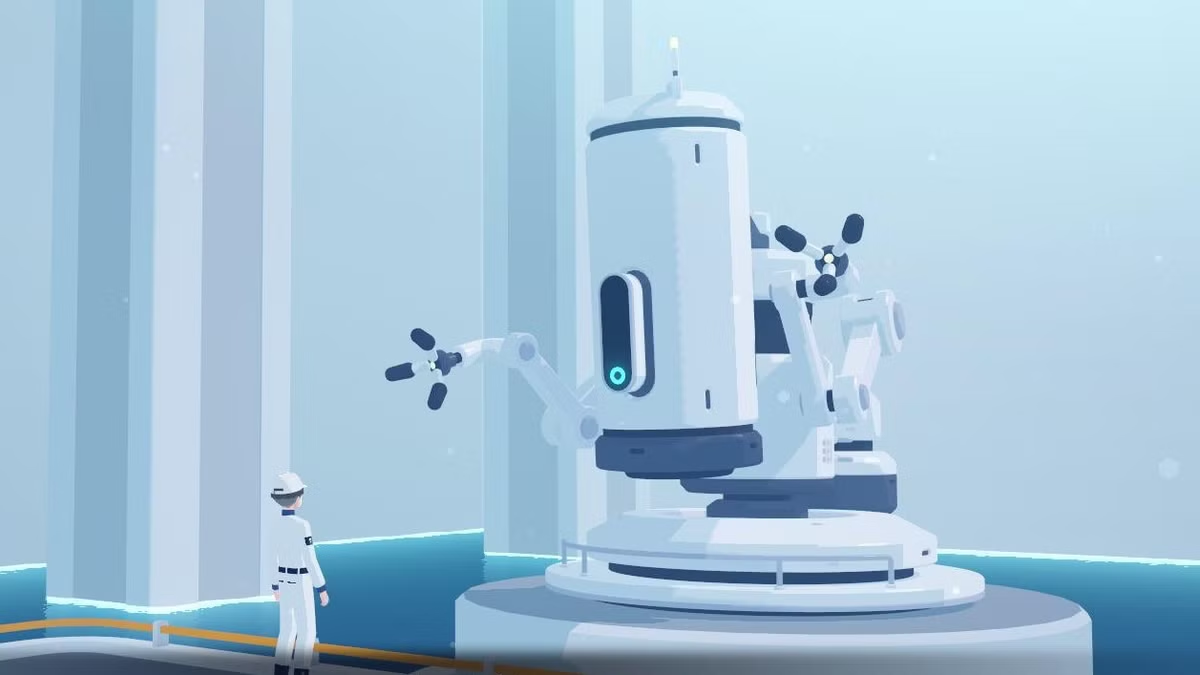
D-topia takes place entirely within a residential district established as part of a futuristic experiment called Utopia Project. The goal of the project is straightforward: to create a community where happiness is maximized, at least for the greatest number of people possible. That’s achieved by putting an AI server in charge, and by creating a fleet of friendly bots to run day-to-day operations. You play the role of a human facilitator living in D-topia who is simply there to fix mechanical mishaps by solving light puzzles. It’s a juicy sci-fi premise that, for much of the game’s runtime, feels like it’s carefully building to an inevitable crisis.
While you wait for the other shoe to drop, D-topia is comfortable with its lightness. The narrative-driven story takes place over seven days that run on a tight routine. You’ll wake up, eat, spend a work shift solving a few puzzles, and help your fellow residents with problems that cold machines can’t fix in order to strengthen your social bonds with them. It’s all perfectly pleasant — the entrancing music, the smooth white environments, the friendly NPCs that speak in Pokémon-style shower thoughts. It all plays out as a sweet slice of life sim rather than a heavy cautionary tale.

The relaxed vibe works early on as it feels like D-topia is building towards something. The puzzles, for instance, carry some minimalist charm. You’re mostly working through number-based challenges that come in a few flavors. Some have you pushing numbered boxes to their respective spots, while others have you navigating mazes and picking up the correct numbers to unlock the exit point. It’s a much lighter version of last year’s challenging Cipher Zero, an excellent puzzle game that has you learning naturally evolving rules on the fly. I never got stuck on a puzzle in D-topia, but that felt right thematically. I’m a worker in a society free from discomfort, after all.
I had a similar reaction to D-topia’s choice-based character stories at first. Each day, one of the characters I could form a bond with presented me with a problem they were facing. Those problems were often in conflict with D-topia’s rules or firm protocols. After talking to characters throughout the district’s small number of areas, I had to work out what to do in a brain flowchart minigame. While you can make cold decisions that will hurt that person in some way, the morally correct solution is always clear. There’s no real punishment for going against the machines to find an amicable solution for all.

My initial enjoyment of D-topia’s breezy pleasures hinged on the idea that everything was building to some challenging conversations. As I spent my carefree hours buying trinkets for my cookie-cutter apartment and learning my neighbors’ backstories over tea, I could catch some simmering tensions in the background. Residents whispered about a slum within the Utopia Project where problem people reside. It started to become clear that maximum happiness for the greatest number of people didn’t mean happiness for all people. There was even a built-in visual motif suggesting that D-topia has a dark side; facilitators can literally peek behind the curtain to fix bugs, revealing the dark machinery underneath D-topia’s shining white facade.
The expected payoff never arrives. There’s some mounting drama surrounding the Utopia Project, but Marumittu Games skirts around any truly difficult questions in the name of coziness. It only challenges the idea that a perfect utopia is possible in broad strokes. The AI-powered robots can’t solve every human problem, but they can still be helpful buddies. There’s still plenty of space for natural joy to bloom within the confines of a soulless big tech experiment. The slum story remains firmly in the background, with a late-game news broadcast only suggesting, in carefully worded terms, that systemic racism could be afoot. It all resolves like an episode of Barney, with simple moral takeaways and a few hugs.
D-topia is entirely about fixing problems, but only ones with obvious solutions.
I can see Marumittu Games’ kind intentions here. The team is aiming for level-headed nuance rather than succumbing to modern-day cynicism. Rather than scolding big tech and the systems that enable it, D-topia wants players to stay hopeful that humanity can always adapt. Even within a world that looks dystopian at a glance, humans will find ways to connect with one another, practice empathy every day, and shapeshift to survive. We are a race of habitual problem-solvers, and any modern anxiety is just a puzzle with an answer. Maybe that’s why there’s practically no friction to be found in any of D-topia’s light systems; to leave players stuck would be to concede that there are some challenges we can’t overcome.
While reflecting on those design decisions, I was reminded of a sprawling 2024 essay by game developer Doc Burford on the subject of cozy art. In it, Burford argues that wholesomeness can lead to complacency — especially in the face of fascism. It’s a sprawling argument delivered in a confrontational tone that ruffled plenty of feathers at the time, but Burford offers a salient takeaway that was worth chewing on even if you don’t agree with the sweeping diagnosis of feel-good art.
“You can’t have hope if situations aren’t bad,” Burford wrote. “It’s not possible to have hope in a world where there is no conflict, because hope is a powerful force within you to fucking fix this shit…”

D-topia is entirely about fixing problems, but only ones with obvious solutions. The puzzles have one answer, and the moral quandaries boil down to picking yes or no on a flowchart with two outcomes. Anything more complicated than that is brushed to the side or left as an open-ended philosophical prompt that you can take or leave. Is there any such thing as a utopia? Can happiness be optimized by machines? Who suffers when a system is designed to benefit a specific class? Don’t give it much thought if you find it upsetting; wash your face and eat the meal that’s been delivered to your living room.
Nothing actually changes within the walls of D-topia after seven days of mild tension. You make some new friends and liven up your boring home with cute furniture, but you’re still confined to the same claustrophobic hallways you wandered on day one of the job, safe from the slums. There’s no hope that anything could change, just that it’s possible to find warmth in the cold status quo. If that’s the most we can hope for in a moment of overwhelming uncertainty, then we might as well power down and let the machines run the show. I have to keep believing that a better world is possible, where comfort isn’t solely achieved through forfeit.
D-topia is out now on Nintendo Switch, Nintendo Switch 2, PlayStation 5, Windows PC, and Xbox Series X. The game was reviewed on Steam Machine using a prerelease download code provided by Annapurna Interactive. You can find additional information about Polygon’s ethics policy here.