




As spring anime season transitions to exciting new titles for the summer, there are plenty of options to choose from. Ongoing anime like Witch Hat Atelier and Daemons of the Shadow Realm have already made strong impressions, while upcoming ones like Red River or The Ghost in the Shell reboot have the potential to become standouts. While Netflix and Crunchyroll act as go-to streaming services for new and classic offerings, Amazon’s anime catalogue remains overlooked in comparison.
Apart from foundational genre hits like Bleach and Naruto, Prime Video is currently streaming everything from That Time I Got Reincarnated as a Slime to Yashahime: Princess Half-Demon. If you’re on the lookout for something short but impactful, the three-part anthology film, Memories (1995), is also available. While there is no dearth of varied options on the platform, here are 10 anime on Prime Video that celebrate the beauty of animation as a medium.
1
Great Teacher Onizuka

Tooru Fujisawa’s Great Teacher Onizuka is an off-kilter shonen comedy. Ex-gang leader Onizuka Eikichi isn’t driven by heroic ideals. Instead, his impulses tend to be sleazy and juvenile. Our crude protagonist wants to become the greatest high school teacher for all the wrong reasons, but he’s forced to develop a conscience in the process. This is unfiltered social satire at its best, as Fujisawa grapples with deviant morality while critiquing the rigidity of social standards applied to formal education. Even someone like Onizuka can grow into a valuable mentor with his ability to empathize with adolescent trauma, allowing him to create a safe space for students branded as delinquents. The story’s comedic mold carries an absurdist streak that melts into a bittersweet vibe that’s hard to forget.
2
Nippon Sangoku
Subversion is the name of the game in Ikka Matsuki’s Nippon Sangoku: The Three Nations of the Crimson Sun. The story begins at the end of the current Reiwa era, during which natural disasters and nuclear war devastate Japan. The government’s failure to protect its citizens leads to a revolt, bringing about unprecedented chaos that causes civilization itself to regress into the Meiji era (1868-1912). Such a dire sociopolitical context builds up expectations for a proactive hero, but Aoteru Misumi is introduced as a passive, contemplative man. Personal tragedy, however, jolts Misumi into action, as he realizes the need for a revolutionary movement. Instead of declaring revenge or undergoing a traditional training arc, Misumi prioritizes shrewd politicking over reckless violence during his quest to reunify the country.
3
Dororo

Acclaimed manga artist Osamu Tezuka gave us celebrated gems like Astro Boy and Princess Knight. His Dororo remains overlooked to this day despite being an outstanding entry in the dark fantasy genre. In this Sengoku-era tale, a young, disabled ronin named Hyakkimaru befriends the orphaned thief Dororo while on a quest to slay demons. Sporting makeshift prosthetics that double as weapons, Hyakkimaru resolves to reclaim his lost body parts with ruthless determination, while the precocious Dororo offers him unconditional friendship. Tezuka Productions (Samurai Warriors) and MAPPA (Jujutsu Kaisen) bring Tezuka’s folkloric inspirations to life with kinetic animation, which also evokes philosophical debates about the line between justice and revenge.
4
City the Animation

City the Animation might’ve been snubbed at this year’s Crunchyroll Anime Awards, but this 13-episode anime is an unconventionally breezy experience. Based on Keiichi Arawi’s manga (his Nichijou series is a must-watch for every anime enthusiast, by the way), City the Animation follows three university sophomores called the Mont Blanc Trio, who navigate the titular city filled with eccentric crowds. This is not a slice-of-life in the conventional sense of the term, as the series’ surreal elements embrace an unpredictable skit-like format. City the Animation is also full of warmth and hilarity, as it amplifies the freewheeling nature of Arawi’s storytelling with stunning visual maximalism.
5
Vinland Saga

MAPPA and Wit Studio took turns to adapt Vinland Saga’s spectacular two-season series (there has been no official confirmation for a third season so far), but nothing about this Viking-era story feels disjointed. Makoto Yukimura’s manga follows Thorfinn Thorsson, who embarks on a revenge quest after Askeladd’s forces kill someone dear to him. The second season takes a more somber, existential turn, leaning into one of the most nuanced character arcs in the history of modern anime. While violence remains at the center of Vinland Saga, the repulsive futility of war is explored in painstaking detail with a shift in focus to those who pay a heavy price during conflict. Instead of following the well-trodden path of bombastic action, Vinland Saga challenges the inevitability of cultural violence by edging towards salvation.
6
Ranking of Kings

Don’t be fooled by the warm, picture-book aesthetic of Ranking of Kings, as this beautiful anime primarily explores the brutality of emotional trauma. We follow Prince Bojji, who is looked down upon by his subjects because he was born deaf and mute. Bojji is also small in stature, which is associated with weakness in a kingdom that values brute strength in their rulers. After Bojji meets Kage, a survivor of the wiped-out Shadow clan, the two strike an unlikely friendship and help each other navigate their cruel reality. This one is a real tear-jerker — the contrast between the purity inherent in the Bojji-Kage dynamic and the violent world they live in reveals uncomfortable truths about how society treats the marginalized.
7
Mushi-Shi

If you’re partial to anime with supernatural elements, Mushishi features primitive creatures (called Mushi) who influence humans like invisible parasites. While some mushi are benevolent, others are malicious, having the ability to drive people mad. Only a few can perceive and understand these creatures, and our protagonist, Ginko, is one of them. While it’s fair to classify Mushi-Shi as supernatural horror, the anime foregoes the knee-jerk emotions associated with the genre in favor of a more mystical interpretation of the premise. Mushi aren’t like curses or demons, as their existence sidesteps traditional morality. Through Ginko’s unique perspective, we’re privy to the toils of human existence and the fascinating, unseen creatures that coexist with nature.
8
Ergo Proxy

Any discourse on edgy, cyberpunk anime is incomplete without Ergo Proxy, which has much more to offer than investigator Re-L Mayer’s viral, iconic blue eye makeup. The worldbuilding alone is intriguing: After an ecological disaster affects breathable air, domed cities, such as Romdeau, become a part of a new hyper-capitalist reality. Androids called AutoReivs are supposed to co-exist with humans, but a string of murders committed by infected androids sets the tone of this dystopian story. Re-L is assigned to the case, which leads a trail to an immigrant named Vincent, who is tied to the existence of god-like beings called Proxy. An infected AutoReiv named Pino joins the duo, kicking off a tense narrative about robot rebellions and the absurdity of sentience.
9
Takopi’s Original Sin

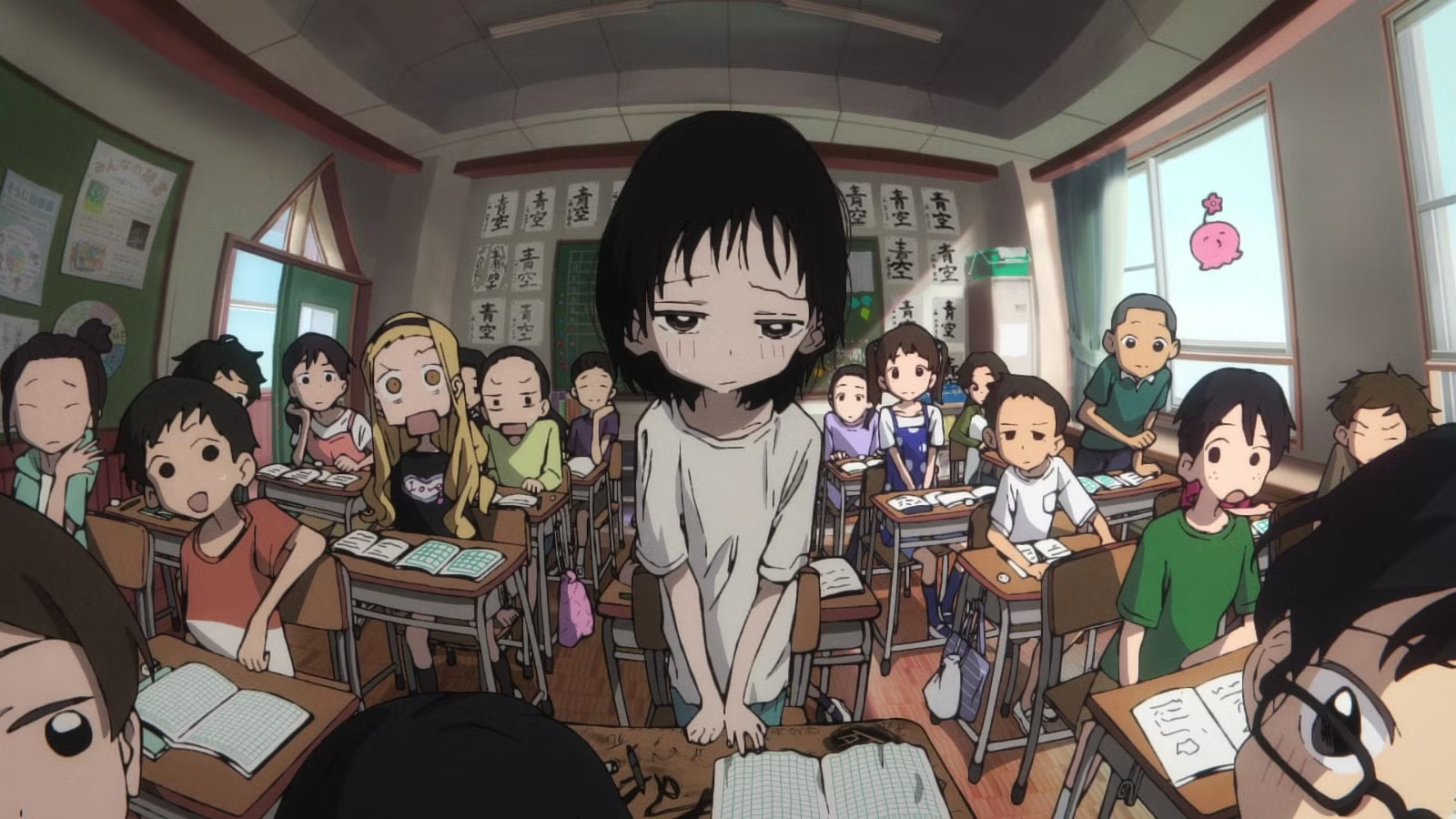
Six episodes are all it takes to be swept away by the jarring, trauma-laden rollercoaster that is Takopi’s Original Sin. A pink, octopus-like alien crash-lands on Earth with the mission to spread happiness, and ends up bonding with a young girl named Shizuka, who names the creature Takopi. Eager to help out Shizuka, who shows signs of being abused and neglected, Takopi offers various gadgets in the hopes that she will be happy. Takopi’s naive outlook instills every scene with humor, which is juxtaposed against the stark reality of a child wrestling with unimaginable trauma. This can be an uncomfortable watch at times, as Takopi’s Original Sin unravels how innocence is lost in a world that revels in inflicting harm without any regard for consequences.
10
Pluto

The follow-up to a story arc from Osamu Tezuka’s Astro Boy, Heisuke Yamashita and Tatsurou Inamoto’s Pluto is as underrated as it comes. While Pluto treats its source material with the reverence it deserves, both the manga and anime venture beyond the depth cultivated by Tezuka’s original. The eight-episode series follows Europol robot detective Gesicht, who must track down an assassin to solve a serial murder case. Things get complicated once Pluto fails to find any human DNA at any of the crime scenes, which also consistently contain clues that point to Pluto, the Roman god of the dead (and the underworld). Pluto takes a grim note of the fact that humanity can never prosper if they don’t reject cyclical violence, lending a sharp political bent to an already stellar narrative.
10 best anime if you like Jujutsu Kaisen
Some of them are battle shōnen, some not — but you’ll be spoiled for choice