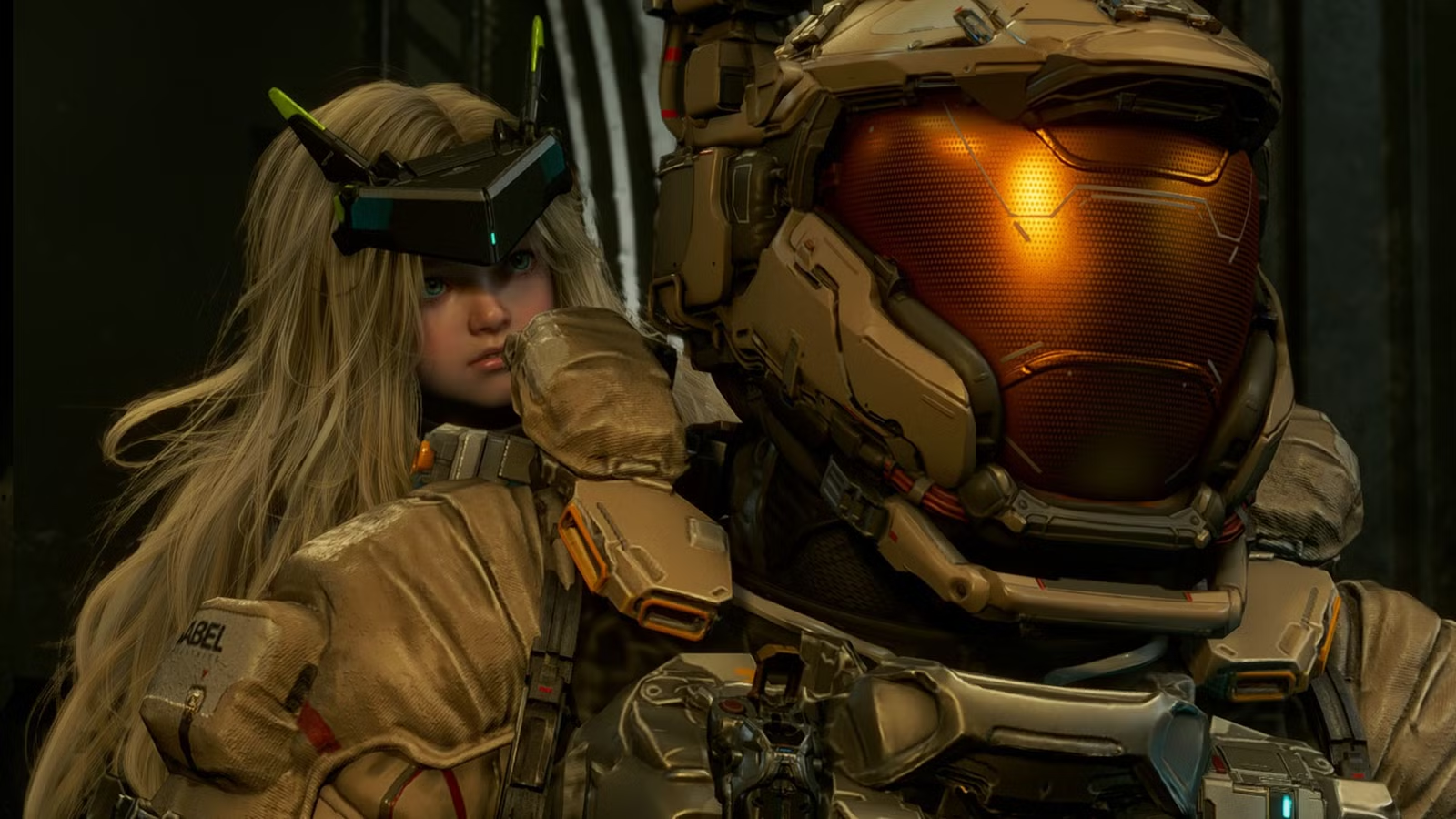




Reviews are in for Saros, Housemarque’s follow-up to its fearsome PlayStation 5 roguelite shooter Returnal. The consensus is that Saros is considerably more welcoming than its infamously difficult predecessor, without necessarily being an easy game. But critics are somewhat split on whether that works in its favor, or whether Housemarque has succeeded in preserving what made Returnal special.
Most reviewers seem to think it has, with reviews netting out at a strong 88 on Metacritic at time of writing. That’s a couple of points higher than Returnal, which sits at 86 five years after its launch. It also puts Saros among the best-reviewed games of 2026 so far, albeit still short of the magical 90 Metascore barrier that no game this year has managed to break through.
GameSpot’s Richard Wakeling was among the many critics who felt that Saros “improves upon its spiritual predecessor in every conceivable way.” In his 9/10 review, Wakeling said Housemarque’s design choices “address every issue I had with Returnal… Its structure is surprisingly malleable, combat is deeper and more rewarding, and I couldn’t resist being wrapped around the finger of its mysterious and foreboding narrative. I find roguelites hit-and-miss, but it didn’t take long before I was utterly infatuated with Saros. It’s an incredible game that does more than just refine what worked before.”
VGC’s Jordan Middler agrees. In his five-star review, Middler said, “Before playing Saros, I was concerned that the wrong lessons could have been learned from those who didn’t click with Returnal, but I’m glad those worries were unfounded. While parts of Saros may feel like a day off for Returnal’s most hardcore devotees, what Housemarque has created is an incredibly tight, polished experience that triples down on what the studio is best at.”
For Kotaku’s Kenneth Shepard, what’s impressive is how Housemarque has retained its distinctive design and narrative sensibility, and resisted dumbing down the Returnal formula. “Housemarque’s ‘house style’ of tough-as-nails roguelike dipped in symbolism has managed to capture lightning in a bottle twice, and in a PlayStation ecosystem where Sony threatens to homogenize all its output, this studio maintaining what makes it distinct in the company’s catalog is just as challenging a feat as anything you’ll face in the game itself. Saros is a prickly, demanding game whose hours of physical and mental carnage will make it difficult to parse for some, but I keep diving back in and finding new philosophical and mechanical challenges to overcome each time.”
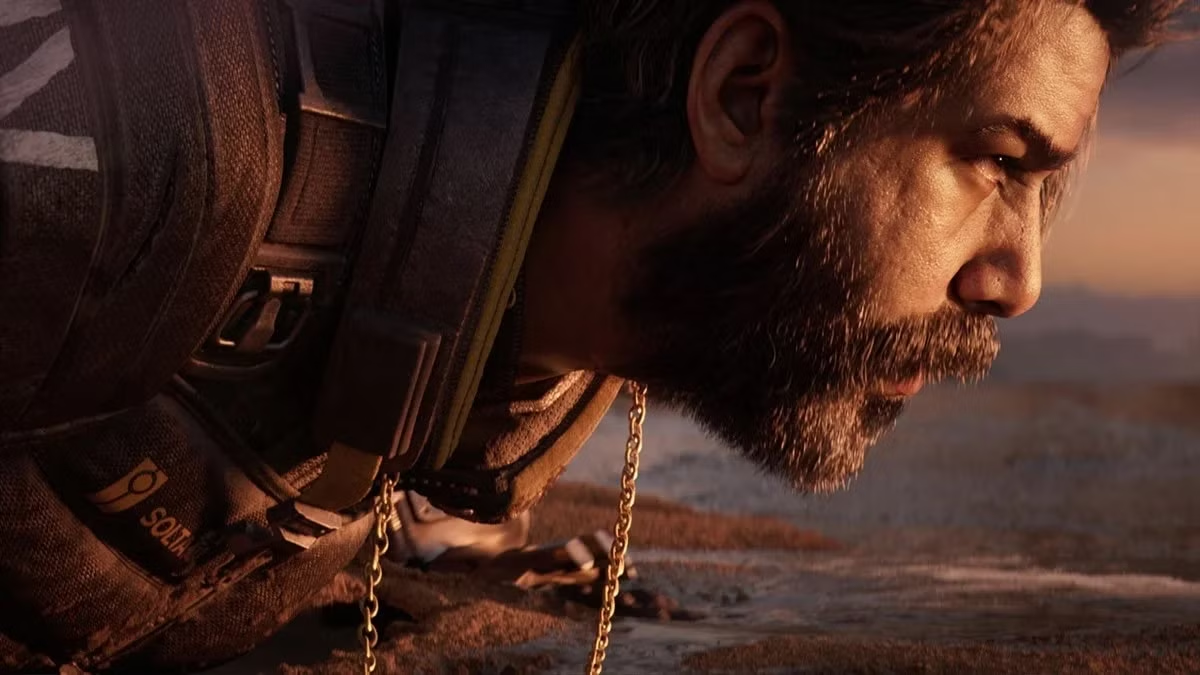
Other reviewers were wowed by Saros as an audiovisual spectacle and overwhelming gameplay experience, perhaps at the expense of its story. At The Verge, Lewis Gordon called it “a euphoric, trance-inducing experience,” and said the protagonist Arjun Devraj “has his own reasons for pressing forward with such bloody-minded intent: namely, a lost romantic partner on Carcosa. Yet this narrative thread inevitably fades during all the psychedelic shootouts. By the end, I saw him less as a person than as a kind of phosphorus energy force. Arjun, and by extension the player, is the catalyst for a game whose kaleidoscopic chain reactions are as beautiful as they are brutal. He is the match that sets this world afire.”
The strongest dissenting opinion — though it’s not all that’s strong — comes in the form of a 7/10 review by IGN’s Michael Higham, who feels that Saros‘ structure and storytelling have been compromised and that it doesn’t live up to Returnal‘s promise. “Saros bites off more than it can chew,” Higham writes. “The roguelite structure doesn’t always work in its favor as it struggles to balance the repetition that’s a natural part of the genre with a strong sense of progression […] There’s a bigger emphasis on story this time around, and it’s more ambitious in some respects which I appreciated — but when its strongest ideas are a bit too abstracted, powerful themes can end up ringing hollow. While it’s eclipsed by its predecessor in some important ways, Saros was still worth banging my head against over and over again. “
The sentiment was largely shared by Giovanni Colantonio here at Polygon, who notes that Saros makes it possible to “turn yourself into an overpowered king by flipping a few switches,” sanding down the inherent challenge of Returnal‘s format. As a result, “there’s no cycle of death and resurrection that pushes you to try some new artifacts or refine your approach to a biome. Both you and Devraj are too protected from danger, something that rings hollow in a story about a brutal world that pushes people to the brink of madness. I found myself wishing that my choices in a run mattered, because it would give me a sign that Devraj was learning and adapting alongside me. Instead, I was consumed by power fantasy.”
Most critics seem to have enjoyed being consumed by that power fantasy, however. Overall, Sony has a winner on its hands, and Capcom’s incredible 2026 run has finally been broken.