




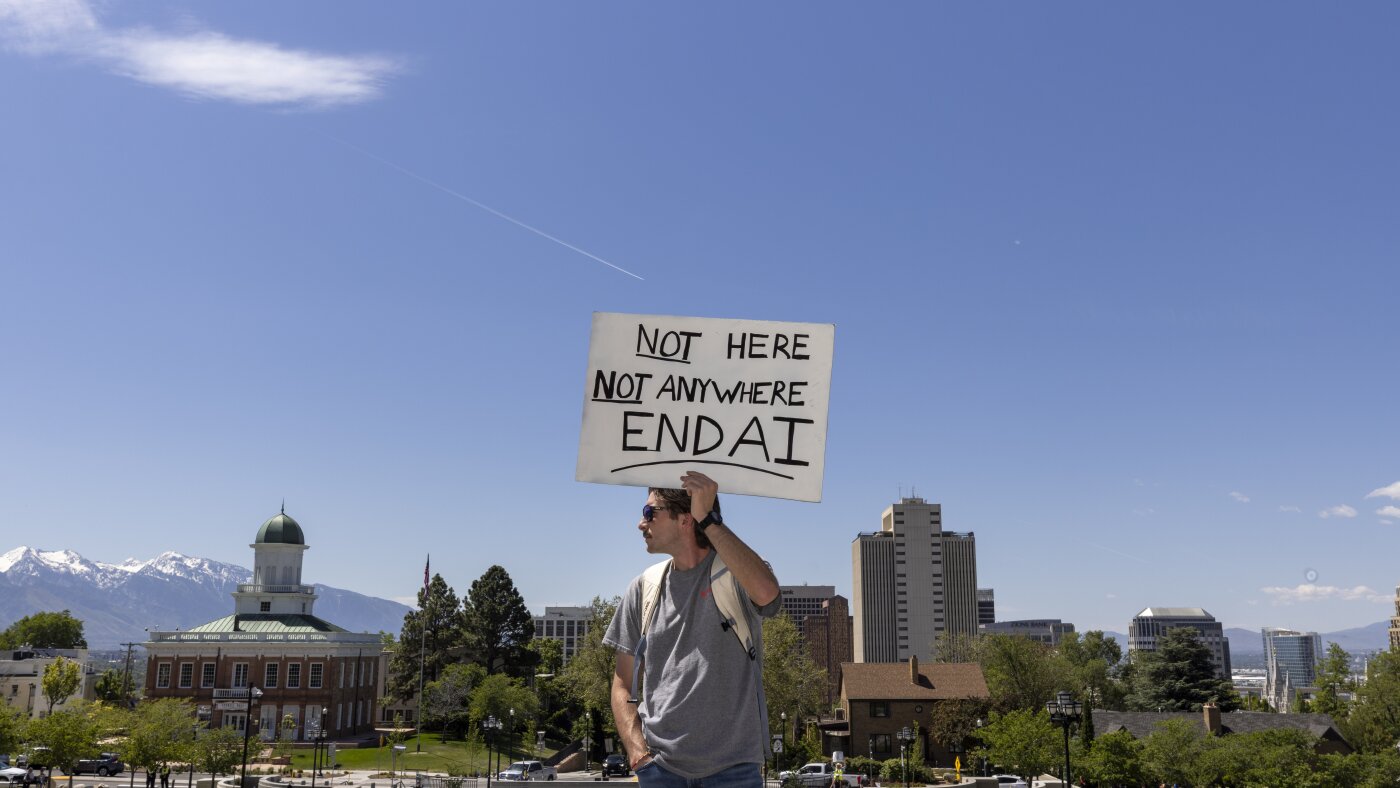

Scott Kwiatkowski from takes part in a demonstration at the Utah State Capitol to oppose the construction of a data center in the state on May 23, 2026 in Salt Lake City, Utah. Support and opposition to artificial intelligence is drawing tens of millions of dollars of spending during the midterm election cycle.
Natalie Behring/Getty Images
hide caption
toggle caption
Natalie Behring/Getty Images
Stay up to date with our Politics newsletter, sent weekly
Groups tied to the artificial intelligence industry are flooding money into the midterms in hopes of shaping future AI regulation.
Around the country, groups associated with AI and tech are trying to influence elections from Senate races to local offices, even as Americans register increasing discomfort with the technology’s ramifications for jobs, energy bills and society. AI-focused super PACs have already spent $43.3 million on congressional races this cycle, according to OpenSecrets, a nonprofit that tracks campaign spending.
The campaign blitz comes against a backdrop of bipartisan consensus that Congress needs to set more rules governing AI and the powerful companies developing it. Yet efforts to advance federal legislation have so far stalled.

The massive spending and heated rhetoric reveal a great deal about the contours of Silicon Valley’s political fault lines and competing visions of what the future should look like.
“This type of spending really helps shape who is at the table and what perspectives they are bringing into those conversations when new legislation is crafted,” said Michael Beckel, director of money in politics reform at Issue One, a bipartisan nonprofit that seeks to reduce the influence of money in politics.
“It’s rewriting the playbook for how industries are trying to exert their influence in Washington and in states across the country,” he said.
The proxy war in Central Park
An early test of how this strategy could pay off will come Tuesday in a congressional primary in New York City that has drawn more than $15 million in AI-backed spending both for and against Alex Bores, a former Palantir employee who is pushing to more strictly rein in the industry.

Bores, 35, is a New York state assemblyman who co-sponsored the state’s Responsible AI Safety and Education Act, legislation that requires AI companies to report safety incidents and publish information on their safeguards.
In October 2025, he entered the Democratic primary race to replace retiring Rep. Jerry Nadler in New York’s 12th Congressional District. It spans the heart of Manhattan, north from 14th Street to the top of Central Park, and has the highest per-capita income in the country.
The primary race — which will likely determine who replaces Nadler in the Democratic stronghold — has become a major battle in the proxy war over federal AI regulation.
After Bores entered the race, super PACs tied to investors in ChatGPT maker OpenAI unleashed a torrent of spending aimed at torpedoing his campaign. An early anti-Bores ad argued laws like New York’s RAISE Act would create a “chaotic patchwork of state rules that would crush innovation.”

Groups linked to OpenAI and Anthropic have collectively spent more than $15 million on pro- and anti-Bores messaging, according to Federal Election Commission filings.
Think Big PAC/Screenshot by NPR
hide caption
toggle caption
Think Big PAC/Screenshot by NPR
Rival Anthropic, an AI company founded by OpenAI defectors that has called for more regulation, is backing super PACs countering the OpenAI-aligned groups’ assault on Bores with millions of dollars of their own.
Groups linked to the two companies have collectively spent more than $15 million on pro- and anti-Bores messaging, according to Federal Election Commission filings.
The torrent of ads, mailers and texts appears to have primarily served to raise Bores’ profile in a crowded field ahead of the Jun. 23 primary.
Corporate rivals fund opposing super PACs
The Bores contest is the most visible arena in which the AI sector’s intramural rivalries are spilling into politics.
In their quest to win the AI race, OpenAI and Anthropic compete for everything from funding and staff to customers. They’re both planning massive initial public offerings later this year. And they are locked in an ideological feud over how AI should be built, commercialized and governed, which shapes their respective views on the role of regulation.
On one side of the political fight is Leading the Future, mainly funded by venture capital firm Andreessen Horowitz, which is an OpenAI investor, and OpenAI’s president and co-founder Greg Brockman. Its stated mission is to “oppose policies that stifle innovation, enable China to gain global AI superiority, or make it harder to bring AI’s benefits into the world, and those who support that agenda.” It argues for a national approach to setting AI standards and safeguards.

OpenAI president Greg Brockman has helped fund the Leading the Future super PAC, which is opposed to stricter regulations on AI companies.
Caroline Brehman/AFP via Getty Images
hide caption
toggle caption
Caroline Brehman/AFP via Getty Images
Leading the Future has raised more than $75 million. It’s already spent $23.5 million on dozens of races from Texas and Georgia to Illinois and Montana through a network of super PACs including Think Big and American Mission, according to OpenSecrets’ tally of federal filings. The group has also funded a PAC supporting Republican Byron Donalds’ campaign for governor of Florida, a hotspot in the state-level fight over AI regulation.
On the other side is Public First, positioned in direct opposition to Leading the Future. In February, Anthropic announced it was contributing $20 million to a related nonprofit, Public First Action, that “opposes federal efforts to freeze state progress without adequate federal safeguards.” Anthropic said the company didn’t want to “sit on the sidelines” while AI policies are developed and warned that “vast resources have flowed to political organizations” that oppose greater AI regulation.

Public First-affiliated PACs, including Jobs and Democracy and Defending Our Values, have spent $16.6 million so far on congressional races in states including North Carolina, Texas and Utah, according to OpenSecrets.
The political antagonism “really mirrors the corporate competition between OpenAI and Anthropic” and their differing approaches to AI development and safety, said Molly White, an independent researcher and tech industry critic.
AI spending is also about sending a message
OpenAI investors and Anthropic aren’t the only AI interests betting that spending on campaigns will reap political rewards. Facebook owner Meta is funding super PACs aimed at shaping AI policy in Texas and California, and both Google and Meta are backing another super PAC focused on California state legislative races.
Billionaire crypto investor Chris Larsen, who has spent millions on local and state races in California this year, launched a super PAC called You Can Push Back that’s spent nearly $2 million backing Bores in New York.

Silicon Valley has long injected money into politics, but in previous cycles that came primarily through individual donations from executives and via corporate PACs, said Katie Harbath, founder of the tech consulting firm Anchor Change, who spent a decade working on public policy at Facebook.
The AI-connected groups’ more aggressive political involvement is “a real experiment this time to see if that sort of money can really sway any of these races in the way that these companies want it to,” she said.
To White, the AI industry’s willingness to flex its financial muscle is about more than one candidate’s victory or loss.
“If Alex Bores is elected, one fairly junior congressperson is not likely to have an enormous impact on the ultimate AI regulation that might be passed in the next couple of years,” she said.
“But I do think that one of the major focuses of these super PACs is really about sending a message to other candidates who might be thinking about coming out in support of stricter AI regulation or coming out in opposition,” White continued. “Whichever PAC is on the winning side will use those victories as sort of a threat towards other candidates.”
Congress remains stalled on AI regulation — for now
The concentration of wealth and power in a handful of giant AI companies has spawned critics across the political divide and at the federal, state and local levels.
While the industry is responsible for the lion’s share of stock market gains in recent years and a sizable portion of the growth in U.S. gross domestic product, concerns are mounting over the effects of AI on jobs, the environmental and economic costs of massive data centers and the safety of powerful AI models.
But in Congress, momentum on AI legislation — along with nearly everything else — remains stalled. Despite bipartisan support to do something about the technology, lawmakers are still hashing out how to even take up the issue.
“So far, the key battle lines have been whether to spend much time on federal AI legislation at all,” said Adam Kovacevich, the founder and CEO of center-left tech industry policy group Chamber of Progress.
Kovacevich says there is interest in the idea of federal standards governing AI development and deployment, but “there seems to be little energy being spent on actually writing those standards before this year’s midterm elections.”
“Almost everyone in Washington agrees AI is transformative and requires some kind of policy response,” said Nicole Alvarez, a senior tech policy analyst at the Center for American Progress, which advocates for progressive ideas.
“The real fight,” Alvarez said, “is what governance looks like.”
An ongoing fight
The AI industry is contributing even more money in the hopes that when regulation eventually comes, they can play a big role in shaping it.
On top of the tens of millions of dollars AI-linked groups have spent so far in this election cycle, AI firms are investing heavily in lobbying — which means the spigot of dollars will keep flowing after the new Congress is sworn in in January.
In 2025, OpenAI, Meta, Google parent Alphabet, and AI chipmaker Nvidia spent a combined $50.9 million lobbying members of Congress, according to a review of federal reports by Issue One.
Those numbers are likely to rise this year. Anthropic more than quadrupled its lobbying spending to $1.56 million in the first quarter from a year ago, while OpenAI nearly doubled its outlays to $1.02 million, according to Issue One’s analysis.
“As companies continue to see a return on investment for those types of expenditures, they are likely to continue to spend more and more and more,” said Issue One’s Beckel.
The outcome of this summer’s primaries and the fall’s general election will have a big impact on the shape any legislation takes.
Even if Republicans maintain control of Congress, the de facto 60-vote threshold in the Senate to pass most legislation means that AI regulation will almost certainly require bipartisan compromise.
Lawmakers will also have to contend with a growing share of the public who feel queasy about AI.
“If our goal as a country is to advance AI development and deployment and achieve leadership in this space,” Alvarez said, “then we cannot exclude the public from the conversation.”
“Undermining their trust is going to lead to them being hesitant to accept this technology in their everyday lives,” she said.