



“Games are secrets, and secrets are games.”
As I smashed through one of the many false walls hiding in Mina the Hollower, Yacht Club Games’ masterful ode to The Legend of Zelda, this quote echoed through my head. It was 2024, and I was demoing UFO 50 with Spelunky creator Derek Yu there to guide me through his collection of 50 retro-inspired games. He suggested I check out Campanella, a tense game where you steer a UFO along a tight obstacle course. Within moments, I activated a “glitch” that warped me forward several levels. Yu was overjoyed that I had just stumbled into one of his intentionally placed secrets before his eyes. When I asked if UFO 50 was full of discoveries like that, he nodded and dropped that bit of sage wisdom.
Yu’s words come to me any time I find a well-hidden secret in a game that makes me light up with glee. I never stopped thinking it — games are secrets, and secrets are games — during my 20 hours with Mina the Hollower. Its pixelated world is so densely packed with delightful discoveries that you can’t trek more than a few screens without getting rewarded for your curiosity. Yacht Club’s adventure game transcends homage status by getting at the very heart of what makes video games so pleasurable, connecting 40 years of design, mechanics, and story in the process.
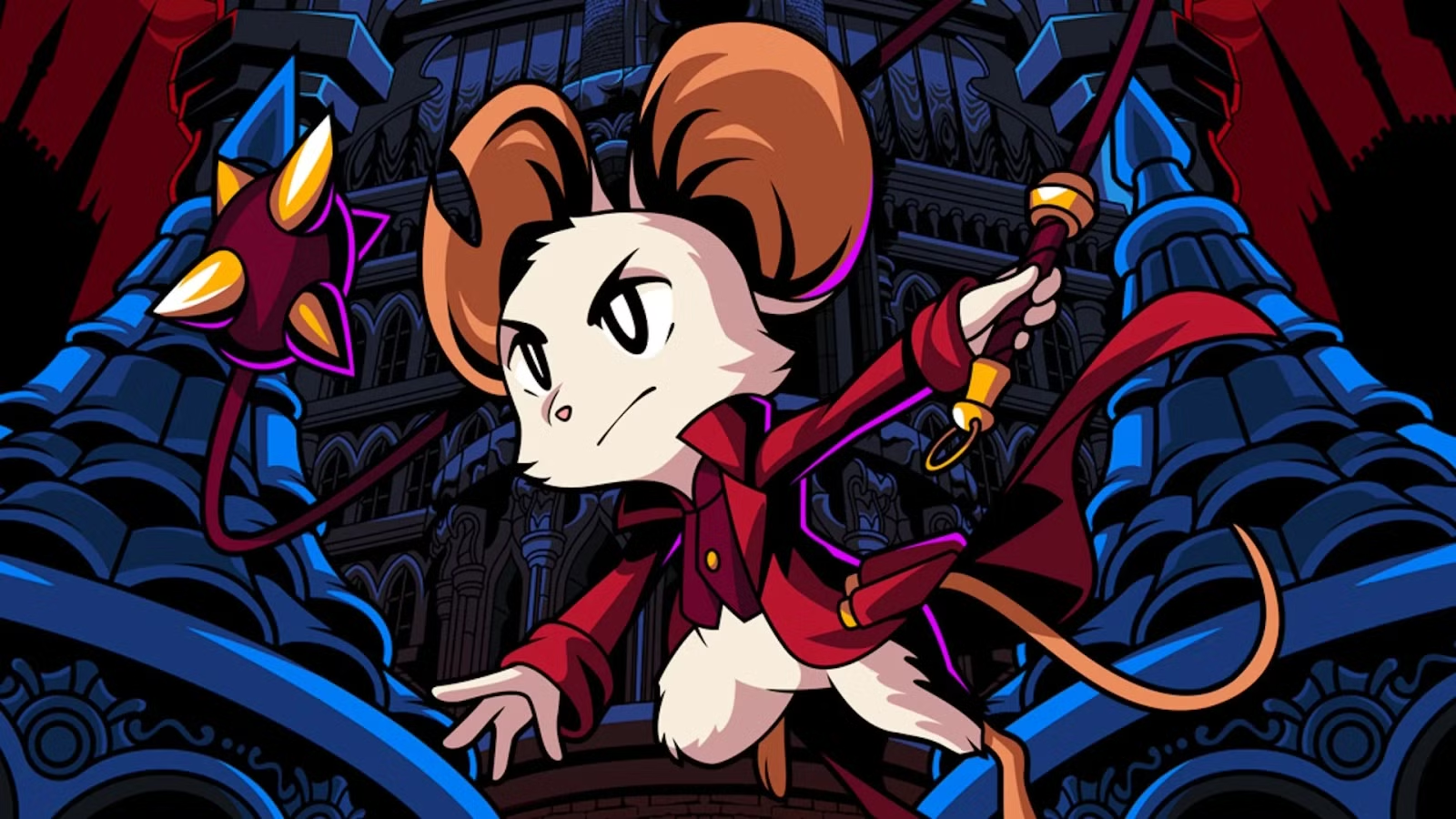
Where Yacht Club’s hit Shovel Knight paid respects to old-school 2D platformers, Mina the Hollower does the same for top-down Zelda adventures, specifically the Game Boy classic The Legend of Zelda: Link’s Awakening — right down to the fact that it begins with a shipwreck. Mina, a tinkering mouse, makes her way to Tenebrous Isle by boat to investigate why the generator towers she built there have stopped working. After crash landing on the shore and finding her way to the city of Ossex, she gets swept into a repair mission by Baron Lionel, who informs her that her handiwork has been destroyed by Thorne, a rogue bat-soldier. That’s enough background to set up a classical video game premise: find the six doohickeys guarded by maze-like dungeons.
Mina the Hollower wears its early Zelda influences like a badge of honor. It’s a proud adventure game built from chunky, expressive pixel art and over 1,200 intricately detailed screens. (Remember when screen count was a metric of game size?) You can feel the original NES Zelda game in its open-ended approach to exploration, and Zelda 2: The Adventure of Link in a bone-fueled level-up system that directly borrows that game’s UI. It’s a pixel-perfect recreation of the kind of Zelda game Nintendo has moved away from as its console and handheld strategies have merged into one. Yacht Club treats limitations as an opportunity, and it never squanders them here.

Even the combat stays true to the classics, with Mina using one of five weapons to whack enemies in four directions. I mostly found myself using her signature flail to get the job done, which can hit enemies from a safe mid-range, but each one is worth experimenting with. Quick daggers, a hybrid gunsword, and a parry-capable shield all slightly change the pace of combat without overcomplicating the precise hack-and-slash Zelda dance. Limited-use sidearms like flying axes and healing dashes add just enough variation to keep fights fresh, but even that is still reverently rooted in retro games like Castlevania. There’s a deep respect for history guiding every little decision.
As true as it is to eras of the past, Mina the Hollower’s hook is not nostalgia. It’s a staggering feat of game design that carries Zelda’s timeless ideas forward every chance it can. Like the original Hyrule, Tenebrous Isle functions as an open-world that you can freely explore in any way you like. The difference is that there’s no linear dungeon order because almost nothing in Mina is gated behind hookshots, boomerangs, or other key items. Mina has the basic tools she needs to explore almost every corner of the map from the very beginning. That includes her deceptively useful burrowing ability, which lets her dig into the ground and move around for a few seconds. It’s handy for dodging enemy attacks and slipping under fences, but there’s so much more to it. You just don’t realize it right away.
Every secret in Mina the Hollower is hiding in plain sight. When I first exited Ossex’s gates to start freely exploring, I noticed some treasure chests in unreachable spots around the city walls. My modern gaming instincts told me that I would probably need some upgrade to reach them, Metroidvania style. About a dozen hours later, after I had discovered every little nuance of Mina’s burrowing power, I returned to that area only to find that I could have reached those chests right away. The same went for upgrades and optional bosses hidden behind breakable walls and well-concealed routes. The very last dungeon I completed in my first playthrough — which took me hours of brainbusting to find a way into — was the very first one I made a beeline to in my second save file. The density of eureka moments is astounding.
Any time Mina borrows something from another game, it always puts its own spin on the idea.
In that way, Mina the Hollower is just as much a cousin to Öoo, one of 2025’s most revelatory puzzle-platformers, as it is to Zelda. Öoo seems simple at first, but the trick is that your bomb-making caterpillar actually has several nuanced abilities at its disposal that you are subtly taught throughout the adventure. Mina the Hollower employs that same idea on a much grander scale, turning an adventure game map into one big puzzle sandbox that isn’t just about lock-and-key gameplay. (Though there are universal Keygears that can be used to open any lock you find in the world.) When you see a health upgrade you can’t figure out how to reach, that’s your invitation to learn something new about how the game works.
I always took that invitation when it was offered to me because every puzzle on Tenebrous Isle is exquisitely designed. The six dungeons, which include a witchy castle and a bayou, are especially satisfying to pull apart. Each one is an intricate maze of ultra-precise platforming gauntlets and spatial reasoning that tests my knowledge and mastery in new ways. The less successful dungeons go a little too far in on frustrating physics-based movement gimmicks like slippery ice and rocking platforms, but the thrill of figuring out how to make a jump that looks impossible or cross a deep body of water never wears off.

Yacht Club goes to great lengths to make sure it’s not creating an adventure game that’s too rigid in the process. There’s a major layer of flexibility at multiple levels. For one, there are various trinkets that can be collected and equipped throughout the game. (Not dissimilar to 2025’s Pipistrello and the Cursed Yoyo, another Zelda throwback that Mina is in conversation with.) They can be as basic as giving Mina a defense boost or as game-changing as letting her burrow into walls. I was able to piece together a powerful build by mixing and matching tools, summoning lightning strikes and killer bugs to make tough boss fights more manageable in creatively fulfilling fashion. There’s also a settings menu full of modifiers that range from helpful accessibility assists to absurd options that make every enemy big. Like Mina herself, you are allowed to be a tinkerer who can tune the adventure to your liking.
Though Zelda is the most obvious touchpoint, there’s an entirely different game you could easily draw a comparison to: Bloodborne. You can feel the influence of FromSoftware’s beloved action RPG in Mina’s gothic world, its wealth of challenging bosses, and its love of shortcuts. Even there, though, Mina feels iterative rather than imitative. Yes, you heal by drinking flasks, but they become more potent the more hits you land on your enemies without taking damage yourself. It’s almost more of a riff on Doom (2016) and the way it encourages players to dive head-first into danger to heal up. There’s a corpse run system too, where you’ll drop all the bones you’ve collected as a Spark upon death, but there are ways to safely bank your currency and to obtain additional Sparks that let you die a few more times before losing your bounty. Any time Mina borrows something from another game, it always puts its own spin on the idea.

In fact, sometimes it’s at its best when it’s inverting the games it’s referencing. Mina packs a deceptively thoughtful story despite presenting itself as typical adventure game fare. What’s initially presented as a basic hero’s journey becomes complicated by the kind of video game empire that heroes like Link rarely dare to question. Is the mission Mina is being sent on actually doing anything to help the residents of Ossex, or is Mina just settling a battle between political rivals? Considering that the west side of town is lined with beggars, broken generators hardly seem like Ossex’s most pressing problem. (But at least the town’s newspaper has had juicier gossip ever since the Baron bought it, an elegantly dressed woman on the east side tells me.)
At this point, I’ve dropped so many video game titles in this review that you might be rolling your eyes. Surely Mina the Hollower can’t be The Legend of Zelda, Castlevania, Öoo, and Bloodborne, all at once! But that’s the magic of Mina: it can, because you can draw a straight line between all of those games. FromSoftware’s games draw on foundational game design principles that powered ‘80s adventure games. Mina the Hollower is just the link between worlds.

Burrow down one layer further, though, and you’ll find an even more fundamental connection between these games that goes beyond genre: They’re all built around secrets. The true game in The Legend of Zelda is discovering false walls you can bomb or staircases hidden under bushes, just as the true game in Bloodborne is hunting down hidden weapons and bosses. Clearing six dungeons is the main objective in Mina the Hollower, but my favorite moment of my playthrough was simply when I commandeered a ladder and dragged it around a swamp to discover a wealth of hidden pathways. All of these games fulfill my curious instinct to poke my head into a foggy door frame and find what lies on the other side. That’s why I’m still drawn to video games even after playing them for over 30 years of my life.
Indulge me as I draw one last comparison: You can link Mina the Hollower to UFO 50, too. They’re radically different games (well, one is 50 radically different games in one), but they are both born from the same modern-retro mindset. Derek Yu understands that the magic of an old game is loading into a world you know nothing about and excavating the secrets within it like a treasure hunter. Yacht Club Games gets that too, building a world of glorious discoveries for its rodent hero to unearth. Mina the Hollower is secrets, and secrets are Mina the Hollower.
Mina the Hollower will be released May 29 on Nintendo Switch, PlayStation 5, Windows PC, and Xbox Series X. The game was reviewed on Windows PC using a prerelease download code provided by Yacht Club Games. You can find additional information about Polygon’s ethics policy here.