




Switchboard is Polygon’s weekly newsletter for all things Nintendo, sent on Thursdays and published on the site on Saturdays. You can subscribe here.
Last week, I wrote about how Nintendo is selling games for less, apparently implementing a more flexible pricing strategy for its first-party releases, as well as doing the previously unthinkable and selling games digitally at a $10 discount. This was against the grim backdrop of layoffs, eye-wateringly expensive hardware, and the $80 code-in-box release of Grand Theft Auto 6.
This week, if anything, the contrast is even more severe. Sony says it will end production of PlayStation games on disc entirely, and the games world braces for Xbox layoffs that promise to be a bloodbath of historic proportions. When did you last hear about dramatic Nintendo layoffs? And the company is certainly the last bastion of physical games, despite the fact that it has more to lose by persevering in that market. Its memory-chip-based game cards were far more expensive to manufacture than a Blu-ray disc even before the current memory shortages drove chip prices through the roof. All of a sudden, even the hated game-key cards don’t look so bad; they may not have the data on the card, but they’re not locked to a license, and you can sell or trade them like any other object that you actually, you know, own.
Nintendo will save us all! As one journalist put it on BlueSky:
Microsoft this week: We’re laying off half the industry.
Sony: We’re ending physical games.
Nintendo: have u seen this splatoon weapon we call it the bloblobber
Now, Nintendo fans (of which I definitely count myself one) have a tendency to cast the company in the role of a sort of jolly, beneficent uncle that makes games for joy, not profit, and never took a self-interested decision in its life. Of course, this is nonsense. Nintendo is as motivated by profit as any other big game company. In fact, it’s more motivated by profit, and this is the point.
Microsoft and Sony, like so many other large corporations, especially in the tech industry, are driven not by profit but by growth. The goal for these companies is to acquire the biggest share of the market as fast as possible and squeeze everybody else out; making money in the here and now is a secondary consideration. This is how they end up spending too much on studio acquisitions they never needed and eventually will close, or on ill-fated live-service pushes, or on vanity AAA projects that can never make their money back, or on the quest for ever-higher-fidelity graphics that people might not be able to actually perceive with their eyes, never mind want.

Nintendo, however, is more interested in making money (and keeping it for a rainy day — it currently has nearly $14 billion in the bank). It pursues actual profit, and despite its “bloblobber” image, it does so in the most boring and sensible way. It makes cheaper, less powerful hardware and keeps game development costs and team sizes down. It retains talented staff — employees stay at the company for an average of 14.4 years. It is comfortable not being at the cutting edge. It’s basically run like a paper mill.
By luck and inclination, Nintendo is very well situated for the present, extremely challenging moment. It’s relatively insulated from the impact of the RAM crisis: Even after a price hike later this year, the Switch 2, with its modest allocations of RAM and storage, will stay on the right side of $500. The games are smaller and made by fewer people, who can keep their jobs, because Nintendo made acquisitions sparingly and frugally (again, it likes money) and didn’t let its development scale get out of hand.
The whole enterprise is sustainable. It’s dull. It’s run by accountants in the sense that the books are balanced and the business reliably makes money, not in the sense that the executives get carried away and the accountants have to clean up the mess by ruining the livelihoods of hundreds of people.
No, Nintendo is not your friend. It might look like the good guy; in fact, it’s the epitome of the boring money man. But, right now at least, those two might actually be the one and the same.
eShop game of the week: Wanderstop
This is the rare cozy game that engages with what’s going on behind our need for coziness; it’s a relaxing but melancholy life sim about the importance of relaxing when you’re suffering from burnout. (The hero of the game is a frazzled fighter working at a tea shop.) “If the slippery and infallible nature of the gameplay is frustrating to seasoned resource management fans, I would argue that that is exactly the point,” wrote The Guardian in a five-star review. “To play while letting go.”
Nintendo Classics game of the week: Super Mario Strikers
If you want to celebrate the World Cup with a retro game on Nintendo Classics, you’ve got two options, separated by 20 years: Soccer on NES, first released in Japan in 1985, or the 2005’s Super Mario Strikers for GameCube. The first game is historically important, but plays a little simply and sludgy today. Not so the first of Next Level Games’ exuberant Strikers series, with its fast, powered-up five-a-side action and immaculate characterization of the Mario cast. It was considered limited as a full release back in 2005, but in this context it’s a blast, especially with a friend.
Nintendo Music track of the week: “The Monsters 1” from Rhythm Heaven Groove
Nintendo’s making a habit of dropping “Special Release” selections from the soundtracks of its latest releases on Nintendo Music; I’d prefer timely full soundtracks, but I’ll take it. This track is from Rhythm Heaven Groove‘s RPG-like battle mode, Beatspell. It takes the series’ relentlessly cheery synth pop in a slightly more atmospheric direction and adds some sick guitar solos that sound like they’re straight from the Mario Kart World sessions.
This week’s most interesting releases
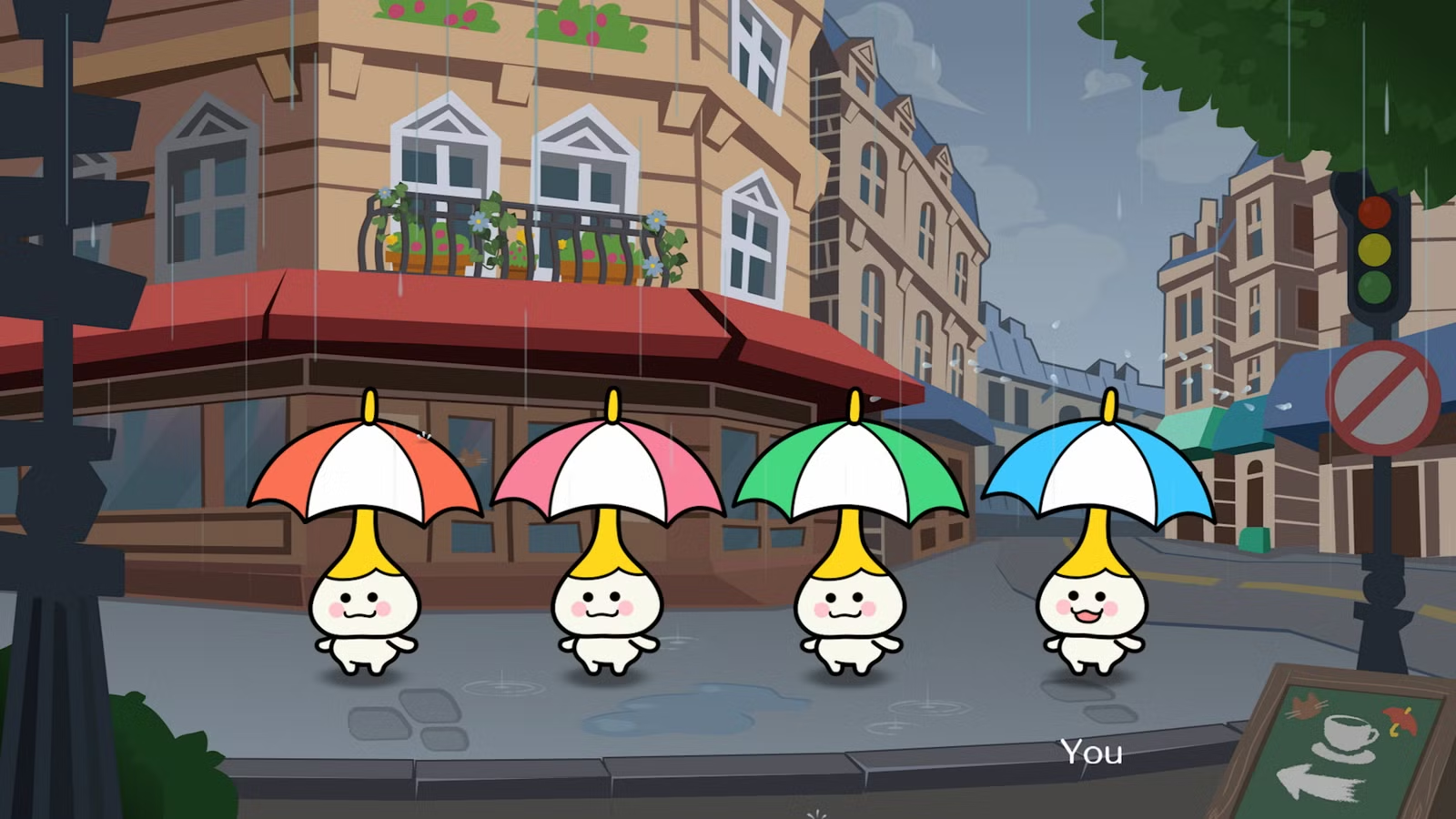
Rhythm Heaven Groove
- July 2
- Switch
- Delightfully surreal rhythm game is the Switch’s swansong
Hyperwired
- July 2
- Switch
- Retro shmup in which you have to plug your ship in to charge it
Bacterium
- July 2
- Switch
- Life sim about engineering microscopic life and watching it fight
Rage District: Humanity Armageddon
- July 7
- Switch
- Honestly, this survival action game looks terrible, but I respect the title