




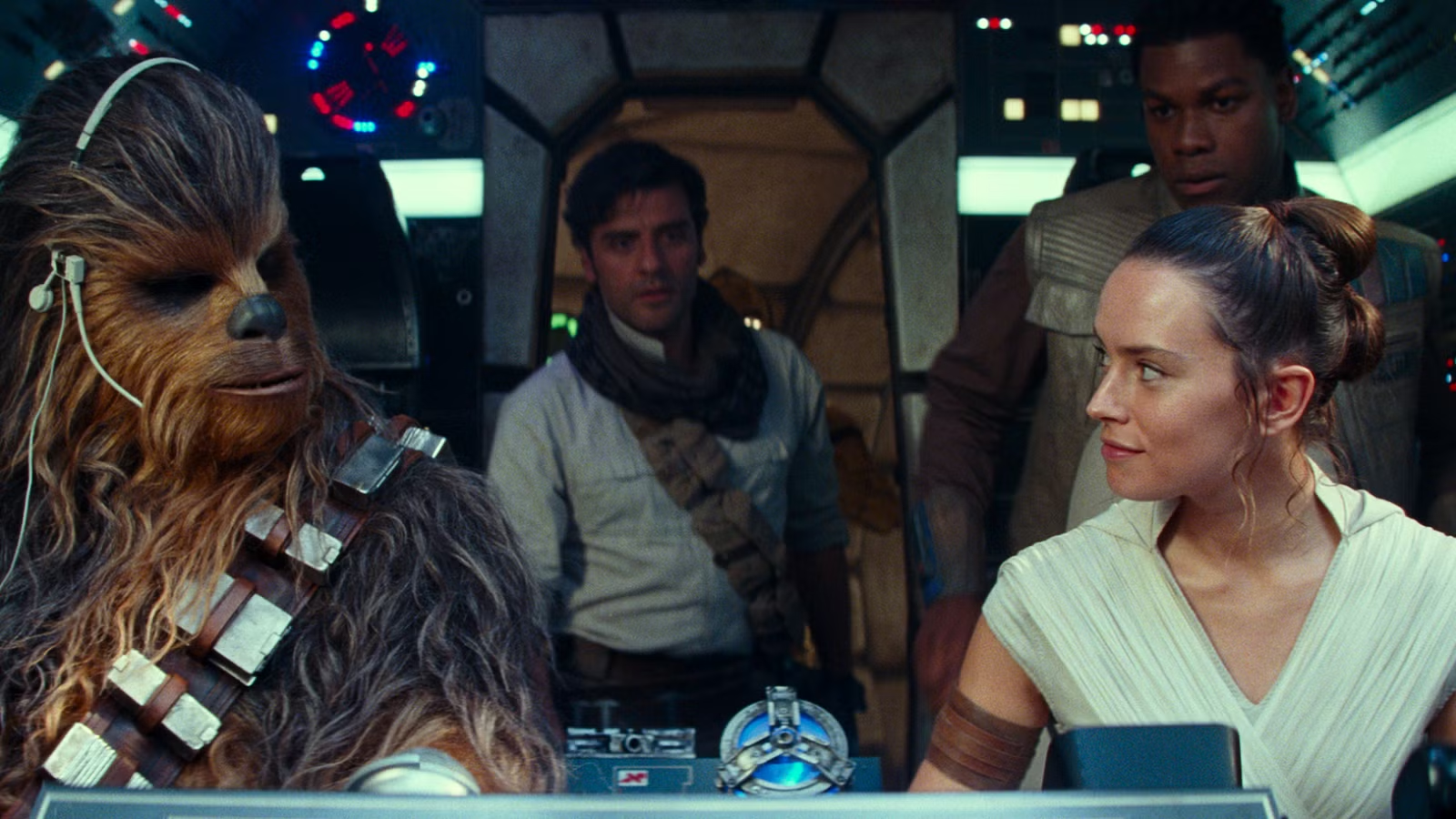
When the first trailer for The Force Awakens hit the internet, there was a surge of excitement. A new trilogy was on the way, led by fresh talent like Daisy Ridley as Rey, a scavenger with a huge destiny ahead of her, joined by other newcomers to the franchise like John Boyega, Oscar Isaac, and Adam Driver. But even better: these new faces would be joined by legacy icons like Mark Hamill, Carrie Fisher, and Harrison Ford. Star Wars fans were hopeful about a new era of greatness for the beloved franchise.
Fast-forward to the present, and the sequel trilogy from J.J. Abrams and Rian Johnson is something that most fans prefer not to think about, along with the many questions it raised. Attempts to answer these questions in expanded material have been largely unsatisfactory.
Published by Random House Worlds, Star Wars: Legacy is a novel by Madeleine Roux, a New York Times and USA Today bestselling author of paranormal, sci-fi, and gothic fantasy, which seeks to answer some of the most pressing questions. The book also confronts the bantha in the room: the scene in The Rise of Skywalker where Rey, at the Lars residence on Tatooine — arguably the birthplace of the Star Wars franchise — takes on the Skywalker name as her own.
With a name like Legacy, it’s not too surprising that Roux’s book grapples with heritage and identity. Even with the sequel trilogy’s many inconsistencies and wild narrative detours, one thing remained consistent: Rey’s desperate attempts to find answers about who she truly is, while also shouldering the weight of being a Jedi with no real idea on what to do next after The Last Jedi. She’s adrift, with no guidance beyond the dark bond she shares with Kylo Ren and the Jedi texts Luke left behind after his death. What’s worse, her lightsaber, originally Anakin Skywalker’s and later Luke’s, is damaged. By the time The Rise of Skywalker comes around, Rey is more confident than when we last left her, but how does she get to that point?
To answer that question, Roux highlights the significance of the bond between Rey and a character whose Jedi potential we never saw in full (in canon, anyway): Leia Organa. Set between The Last Jedi and The Rise of Skywalker, Star Wars: Legacy depicts Rey as she seeks a way to heal the kyber crystal in her lightsaber, while also struggling with the scars of her past. The Jedi’s research leads her to the planet Tython, where a special Jedi forge is said to be located. To Rey’s surprise, Leia joins her on her mission, alongside Chewbacca, R2D2, and C3PO.

Tython has always played a significant role for Jedi. Fans of The Mandalorian will remember Tython as the planet Din Djarin took Grogu to meditate in an effort to find other Jedi like him, alerting Luke Skywalker to Grogu’s existence. Luke would return to the planet many years later in the novel Shadows of the Sith, to learn more about the Sith Eternals at Force-henge, a Jedi temple. It’s no wonder, then, that Rey inevitably finds a deep connection there, uncovering a Jedi temple and recordings detailing a Jedi community lost to time.
Rey’s determination to figure out everything on her own is fuelled by a life of isolation and abandonment. Her desire to find a community and belonging leads her to spend much of her time during Legacy trying to hide her darkness, stuffing it down and pretending it doesn’t exist. Leia, being the daughter of Darth Vader, is all too aware of what it feels like to fear your own inner darkness, and steps into the role of Master that Luke left behind to try to weather the storm brewing inside her conflicted apprentice. That comes with its own growing pains. As it turns out, it isn’t just Rey who is holding back. Leia has been forged by war since she was a young woman, and the losses she’s experienced, namely Han, Luke, and Ben, have left her just as hurt and lonely as Rey.
While Rey yearns for the belonging that comes with identity, she rejects the parts of herself she dislikes. On the other hand, Leia dreams of a life in which she doesn’t reject her Jedi training with Luke and saves the galaxy from the First Order before she loses the people who mean the most to her. The result is two very different women brought together by the knowledge that they owe it to themselves — and to the ones they’ve lost — to embrace who they are, warts and all, rather than lament who they could be.

The lesson Rey and Leia share gives the final scene of The Rise of Skywalker even greater significance than it already had. While the film revealed that Leia had been teaching Rey after Luke’s death, we didn’t know just how important their bond was. As it turns out, without Leia’s patience and willingness to share her regrets and vulnerabilities, Rey’s descent into the Dark Side may have been guaranteed.
The relationship between Rey and Leia is complex, but the love between them is impossible to miss, and so maternal in its nature that it lends greater weight to Rey’s declaration that she’s a Skywalker. Luke may have nudged Rey in the right direction, but as Legacy reveals, Leia proves to be the superior master.
Star Wars: Legacy will be released on July 28.