



In July 2000, Final Fantasy 9 launched in Japan. As the last PlayStation entry in the series, it featured numerous familiar elements, ranging from magical crystals to black mages with pointed caps. Many players saw the game as a love letter to everything that made Final Fantasy great, and a fitting swan song for Hironobu Sakaguchi before he left Square to found Mistwalker.
Just one year later, Square brought the beloved franchise to PlayStation 2 with the ambitious Final Fantasy 10. The game once again featured frequent nods to past triumphs, while also marking the point when experimentation became more routine within the series.

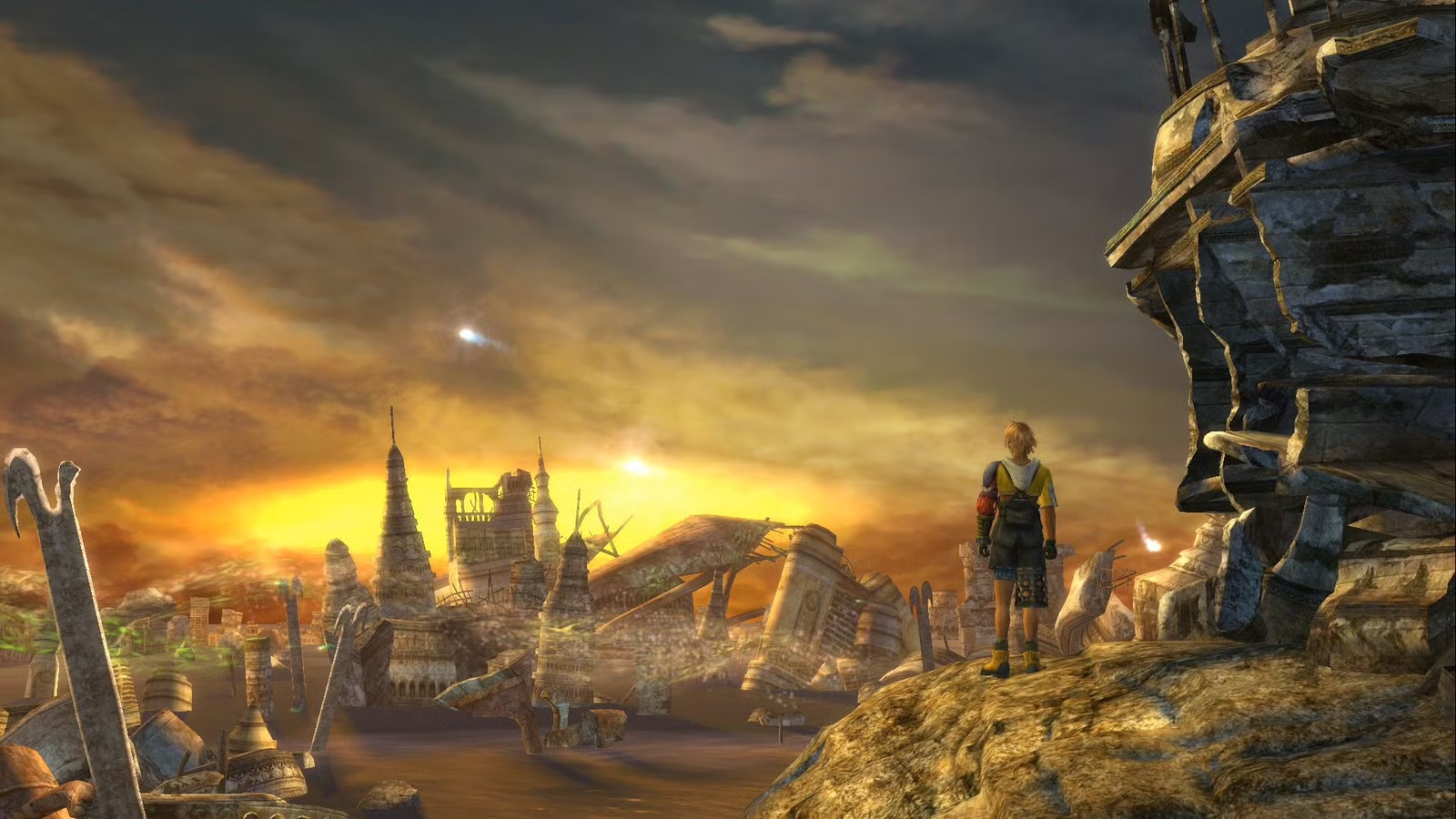
Final Fantasy 10 introduces Tidus, a famous blitzball player with a dark past. When a huge monster known as Sin destroys the bustling city of Zanarkand, Tidus is hurled into the world of Spira. There, he teams up with a variety of memorable characters, including a summoner named Yuna. The group of uneasy allies journeys the world searching for a way to destroy Sin for good, but that quest requires an unthinkable sacrifice. Knowing there has to be a better way, the companions work together to break a tragic cycle and save Spira, even as their faith and friendship are tested like never before.
At the time of its release, FF10 brought storytelling to a level few players had ever seen. For the first time, central characters were voiced. They cried, yelled, and even laughed. Sometimes, they laughed a lot. Players had certainly developed deep connections with heroes from prior Final Fantasy games, but Square made that process easier than ever before with Final Fantasy 10. The plot credibly explored the depths of characters we loved getting to know, from their noblest virtues to their most persistent prejudices.
The world itself didn’t expand the same way. The sprawling overworld maps from past entries vanished, replaced by more confined set pieces. As a tradeoff, most of those environments were finally presented in 3D, instead of the pre-rendered backgrounds of the series’ PS1 era. As a result, the world – at least the parts of it we got to see – came alive like never before.

The overall gameplay also evolved. The most obvious changes related to the combat system. Square finally abandoned the ATB (active time battle) system it had introduced in 1991’s Final Fantasy 4, replacing it with a more streamlined approach that let players swap out party members and make hasty decisions without waiting for gauges to fill. The snappier combat still allowed creativity when the situation warranted it, but it didn’t enforce unnecessary delays elsewhere.
Besides allowing players to swap characters out of the party in the middle of battle, the combat system let them summon huge beasts known as aeons. In previous Final Fantasy games, such moments usually featured a cutscene depicting a powerful entity like Shiva or Ifrit, which would unleash a massive attack before vanishing. In Final Fantasy 10, those monsters stuck around and engaged in battle with enemies. They even used powerful attacks known as Overdrives, turning a summon into a proper event instead of just one attack.
Another big change happened outside battle, with the “sphere grid” that fundamentally changed how characters developed. It has been the basis for similar systems adopted by subsequent games in the series. Characters still gained experience from combat, but players moved along sprawling grids to choose where those points were spent. They could aim for increased health improvements or more powerful attacks, or even access skills. A magic user might lean into supplemental attributes, or explore other proficiencies, all at the player’s discretion.

With the above changes and others besides, Square ensured that Final Fantasy 10 would linger on the mind long after players explored the last of its content. It’s easy to see why some fans consider it one of the finest entries in the entire series, and why Square made a remastered bundle featuring the game and its sequel that is available on most gaming hardware you’ll find today.
After Final Fantasy 10, Square released Final Fantasy 11, an MMORPG. Soon after that, 2003’s Final Fantasy 10-2 arrived as the first direct sequel in the series, expanding the story while introducing new mechanics and characters. The mainline Final Fantasy games released since then have always offered visual and aural excellence layered across deep mechanics and lore, but they never have felt routine or predictable since Final Fantasy 10 came along and broke the mold.