




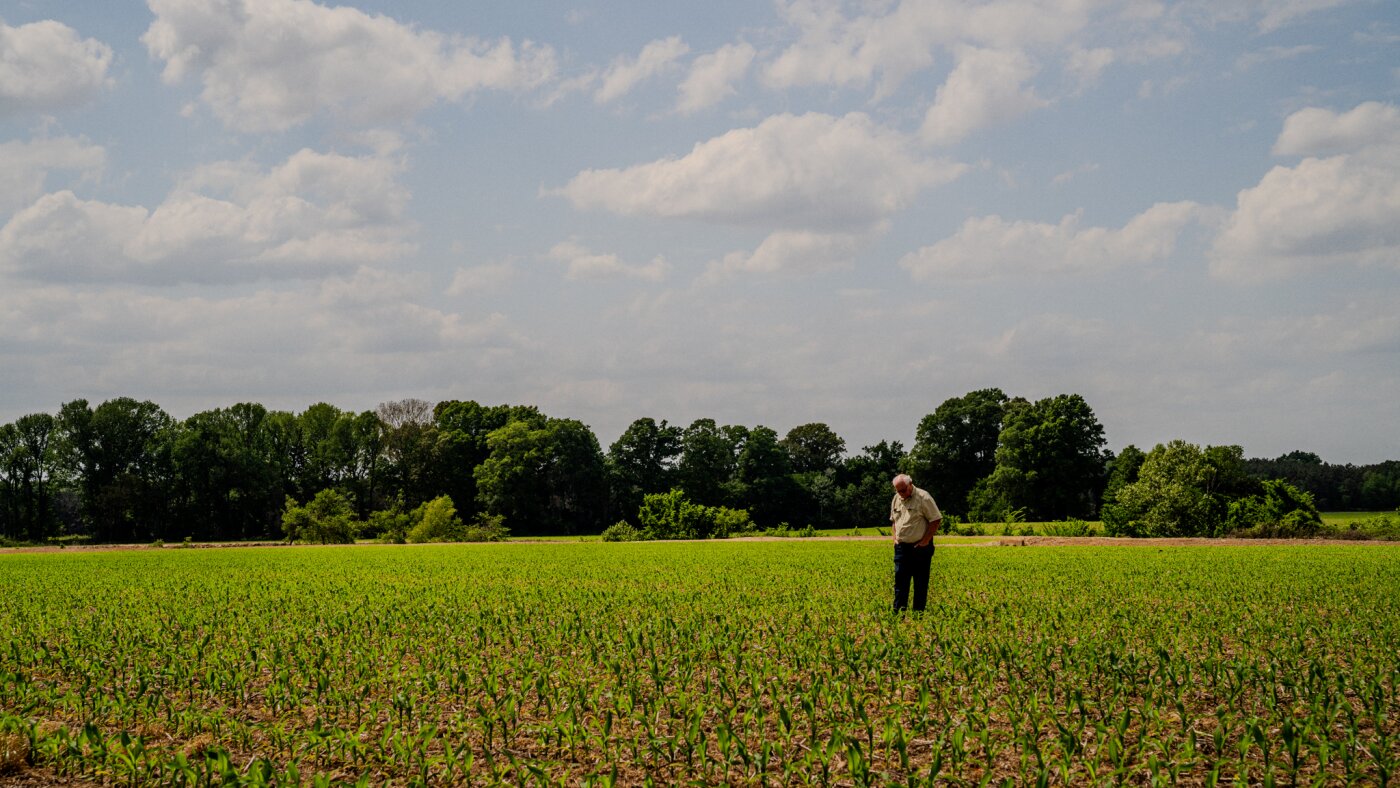

Sledge Taylor, 73, walks his corn fields just outside Como, Miss. on Friday, April 17, 2026. The corn stalks are currently between vegetative stages known as V3 and V5, normally when Taylor would be applying nitrogen fertilizer. But he said he may not do it this year because of the cost of fertilizer.
Jay Marcano for NPR
hide caption
toggle caption
Jay Marcano for NPR
COMO, Miss. – On a bright, dry Friday morning in Panola County in the Mississippi Delta, Sledge Taylor did the same thing he’s done every morning for the last 53 years — the same thing his father did every morning, and his father before him. He walked his fields.
The little green stalks of corn he grows on about 4,000 acres are between vegetative stages known as V3 and V5, tallied by the number of visible leaf collars on the stems. It’s a critical stage for determining future yields, when the plant’s roots claw deeper into the dark alluvial soil.
The Mississippi River built the Delta over thousands of years, depositing layer upon layer of topsoil as it shifted and wandered across the floodplain.
Today, the river runs just over 30 miles to the west, leaving behind some of the most fertile farmland in the country, adding to Mississippi’s $9.5 billion in total estimated agricultural production in 2025.
Normally, this is when Taylor would use a 20-inch diameter steel disk to slice the soil open beside the plants and add nitrogen fertilizer.
“But I may not do it this year,” he said, “because of the price of nitrogen and the low price of corn.”

Corn stalks in Sledge Taylor’s fields just outside Como, Miss. on Friday, April 17, 2026. The corn is ready to be fertilized, which can help increase their future yields. But fertilizer prices have spiked because of the closure of the Strait of Hormuz, and Taylor says he may not use nitrogen fertilizer this year.
Jay Marcano for NPR
hide caption
toggle caption
Jay Marcano for NPR
Nitrogen is a critical fertilizer for farmers. About one-third of the world’s supply flows through the Strait of Hormuz, which is currently closed amid the US-Israeli war with Iran. It’s the same with roughly 20% of global fuel.

Taylor has resorted to buying diesel fuel in small batches — “hand to mouth” as he calls it. He has storage capacity for more than 20,000 gallons on the farm. Right now, he’s sitting on about 1,000.
“Sometimes we know that we’ve only got two weeks of fuel,” he said.
The war couldn’t have come at a worse time. It’s spring — planting season — when Delta farmers are burning the most fuel and spending the most on fertilizer.
And they were already struggling.
The Trump administration’s tariffs, and other countries’ retaliatory measures that followed have gutted the export markets Delta farmers depend on, leading to major losses for small farmers like Taylor who is now also grappling with rising costs caused by a war thousands of miles away.
A loyal Republican whose patience is ‘wearing thin’
China has largely stopped buying American soybeans. Rice exports to Latin America cratered. Corn prices plummeted. Cotton markets’ prices bottomed out.
“Everybody picks on the thing that’s one of our bigger exports,” Taylor said. “They quit buying all of our crops. We have lost customers forever. They will never come back. Because we’re deemed an unreliable supplier.”
Taylor said he’s a lifelong Republican. He voted for President Trump in 2024. He applied to receive relief from the administration’s $12 billion Farmer Bridge Assistance Program — a one-time payment designed to offset tariff losses.

Sledge Taylor, 73, stands among the rows in one of his corn fields just outside Como, Mississippi on Friday, April 17, 2026. The corn stalks are currently between vegetative stages known as V3 and V5, normally when Taylor would be applying nitrogen fertilizer. But he said he may not do it this year because of the cost of fertilizer.
Jay Marcano for NPR
hide caption
toggle caption
Jay Marcano for NPR
The Trump administration argued the payments would help farmers until their economic policies, such as lowering some taxes, would take effect.
Taylor received a payment in March, he said, declining to disclose the exact amount. But he said it covered only about 20 percent of what he actually lost last year, and his patience with the Trump administration is “wearing thin.”
“If somebody took $100 out of my pocket and then turned around and gave me $20 back, patted me on the back and said they were my friend, I’m not really sure I would agree,” he said.
Delta farmers like Taylor have weathered hard times before. He remembers the farm crisis in the 1980s, when falling crop prices, high interest rates, and a collapse in land values forced banks to fail and thousands of family farms into foreclosure.

A water tower in the town of Sledge, Miss. on Friday, April 17, 2026.
Jay Marcano for NPR
hide caption
toggle caption
Jay Marcano for NPR
But he’s never seen prices fluctuate as wildly as they are now. Standing in his field, thinking back on those times, Taylor said it’s worse now than it was then.
“We got people that were barely struggling to get by, and now they’ve been hit with two major increases for fertilizer and fuel just exactly at the wrong time when we need them,” Taylor said.
“It’s going to be the nail in the coffin for a number of farmers.”
In a statement, a spokesperson for the USDA said the Trump administration has provided over $30 billion in ad hoc assistance to farmers since January 2025.
The USDA did not directly respond to questions from NPR about whether additional payments similar to the farmer bridge program are being considered to make up for current losses or what the agency is doing to help farmers deal with higher fertilizer and fuel costs.
‘The ants are getting crushed’
A few miles down the road, near the town of Sledge, Mississippi — land once owned by WD Sledge, Taylor’s namesake and great-great-grandfather — Anthony Bland is doing his own math, and it isn’t adding up either.
Bland grows rice and soybeans on about 2,000 acres. Like most farmers in the Delta, he introduces himself by listing how many generations his family has been farming.

“From the cotton fields to what we’re doing now,” he said, tracing his lineage in a single sentence heavy with history and significance.

Anthony Bland, 58, leans over his truck in one of his fields in Sledge, Miss. on Friday, April 17, 2026. When asked if he would continue farming, Bland referenced the definition of insanity as “doing the same thing expecting different results,” adding, “with tariffs on top of the war, we know the results aren’t going to get any better.”
Jay Marcano for NPR
hide caption
toggle caption
Jay Marcano for NPR
“King Cotton” once reigned supreme in the Mississippi Delta across vast plantations, and the legacy of slavery and Jim Crow still echoes through the wide, flat fields. Only a few years ago, Black farm workers in the Delta settled lawsuits over claims white laborers from South Africa were paid more for the same work.
Farmers in the Delta also face challenges specific to the region. Unlike Midwest farmers, who can largely rely on rainfall, Delta farmers like Bland depend on diesel-powered pumps to irrigate their fields. This spring, a record-breaking drought has made those pumps run longer and harder — burning through even more fuel at a steep cost.
“Right now I’m paying 60% more for diesel fuel than I would have been paying 45 days ago,” Bland said.
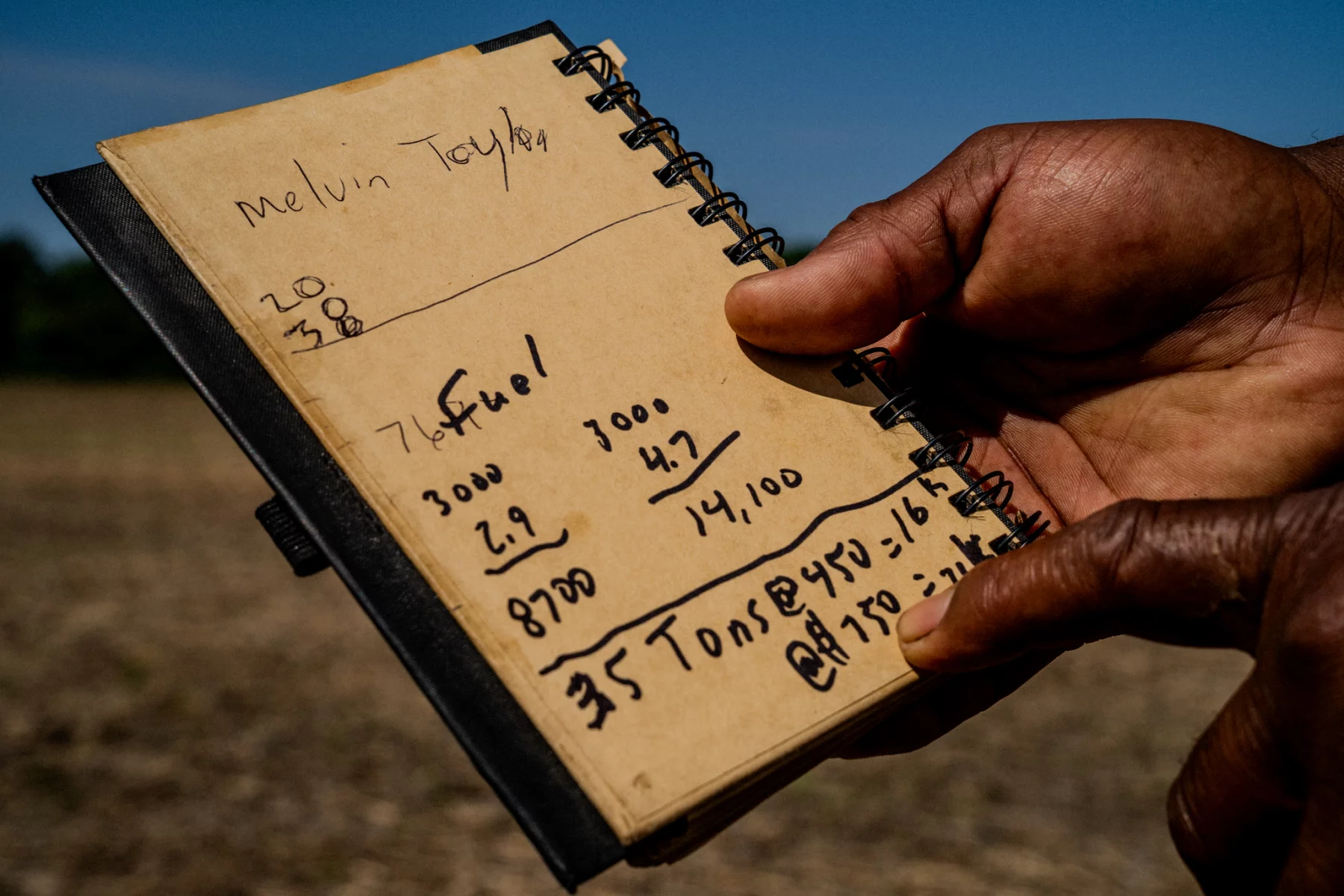
Anthony Bland holds a notebook he’s used to calculate diesel fuel and fertilizer price increases, which have spiked due to the closure of the Strait of Hormuz.
Jay Marcano for NPR
hide caption
toggle caption
Jay Marcano for NPR
He’s also facing a sharp jump in fertilizer costs. Last year, the 35 tons of fertilizer he uses on his rice and corn cost him around $16,000. In a notebook he carries in his back pocket, he’s penciled in $26,000 for the same amount this year. And that’s before accounting for everything else — parts, equipment, insurance — all of it climbing while his commodity prices stay flat or fall.
Like Taylor, Bland received money from the Farmer Bridge Assistance program. He estimated it covered about a quarter of his tariff losses.
He’s also navigating the Trump Administration gutting decades-old USDA programs designed to assist Black farmers. Those programs existed in part because Black farmers have historically faced discrimination from lenders and government agencies — and because they tend to operate at smaller scales, with less financial cushion to absorb sudden shocks.
Unlike Taylor, Bland did not vote for Trump in 2024.
“I just have a problem with the way they’re treating anybody that doesn’t look like him,” he said referring to the Trump administration.
But both men said they don’t support the war with Iran and they don’t know if they’ll be able to continue farming.

Anthony Bland walks one of the fields he’ll plant soybeans in on Friday, April 17, 2026. Bland used to grow rice as one of his main crops, but retaliatory tariffs placed by other countries in response to President Trump’s tariffs have caused the price of rice to plummet, so he’s pivoted to growing more soybeans.
Jay Marcano for NPR
hide caption
toggle caption
Jay Marcano for NPR
It’s a “make or break” year for Bland. He may stop planting the fields his family has planted for generations, lease out his land, and do something else.
Taylor hoped this year would be better than last, but he said it’s starting off worse, and there’s a limit before he decides to call it quits.
“There’s an old African proverb,” he said, looking out across the rows of green corn stalks. “‘When elephants fight, it’s the ants that get crushed.’ The ants are getting crushed.”