




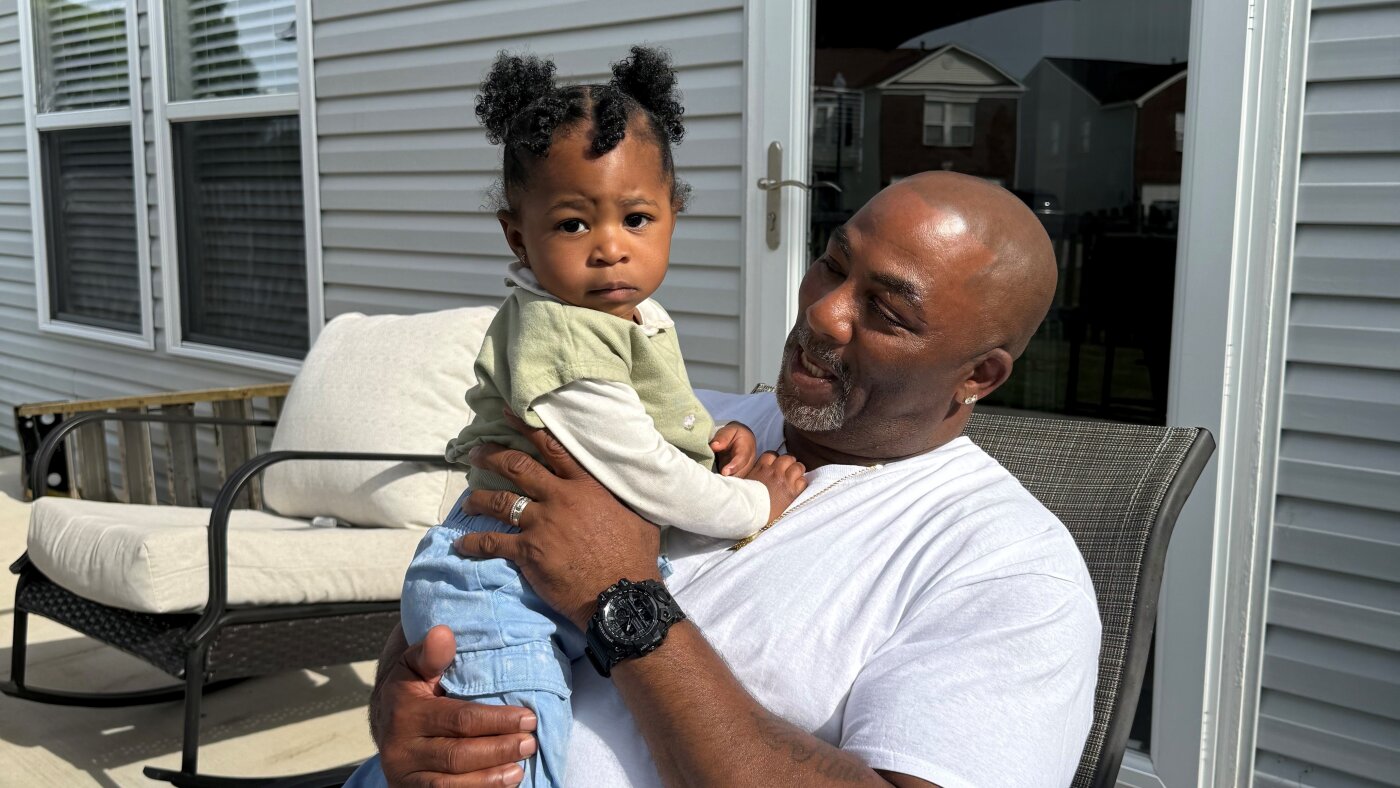

Anthony Bailey, 61, holds one of his grandchildren in this May 2025 photo.
Via Anthony Bailey/Family
hide caption
toggle caption
Via Anthony Bailey/Family
Two years ago, a judge freed Anthony Bailey after 27 years in the federal penitentiary, giving him a second chance at life.
And Bailey has been making the most of his early release. Between long hours driving a city bus in Indianapolis, attending barbecues and playing card games with family, Bailey has developed deep roots in his community.
Now, after a ruling from the Supreme Court and a legal move by the Justice Department, Bailey, 61, is facing a return to prison in a matter of weeks.
“I’m hoping and praying that everything turn out and I get my life back,” Bailey said in an interview. “Today, right now, I’m a better person — I’m a productive citizen, I work hard.”

Bailey’s case is one of about a dozen that could be directly affected by a Supreme Court ruling in late May that limited how prisoners can use the compassionate release program to get out early.
The high court found that the compassionate release program, designed for extraordinary or compelling circumstances, is supposed to cover such things as severe illness or old age. The court majority said inmates serving much longer sentences than the punishments they would receive today were not automatically eligible for the program.
Retired federal Judge John Gleeson disagrees with that ruling.
“These are indefensibly long sentences, and they need to be corrected,” he said. Gleeson launched a pro bono program that has helped more than 100 people in prison petition the courts for early release.
Most of those inmates are Black men who used a gun in connection with other crimes. Prosecutors added severe mandatory penalties to their cases, stacking those punishments, even if no shots were fired, to build prison terms of 50, 60 or even 100 years.

Anthony Bailey (left) poses with family members shortly after his release from prison in July 2024.
Via Anthony Bailey
hide caption
toggle caption
Via Anthony Bailey
“Productive member of society”
That’s what happened in Bailey’s case.
On Sept. 3, 1997, Bailey and two other men robbed a bank and then carried out two carjackings. Prosecutors said in court papers that his crimes were serious and put several people in danger, including a school-age girl.
“Something that I totally regrets — will never happen again, ever, in life,” Bailey said.
He spent most of his time at the federal prison in Terre Haute, Ind., where he worked as a barber — a job that gave him access to scissors and other sharp tools.
His record inside prison was clean for decades, with just one minor infraction mentioned in court filings.

Maryam Kanna is a pro bono lawyer for Bailey. She said he has already served more time than most people convicted of federal murder.
“He has a stable, happy life and is a really productive member of society, so I mean, the idea that he poses a danger is completely farcical,” Kanna said.
Congress changed the law, but not retroactively
Prosecutors are now signaling that they could move soon to send Bailey back to serve the rest of his long sentence — one that would give him a release date in 2050, when he is nearly 86 years old.
Kelsie Clayton, a spokesperson for the U.S. attorney in the Southern District of Indiana — where Bailey’s case is pending — said the office speaks only through official court filings.

Congress has since lightened some of the harsh mandatory penalties that applied to Bailey and others convicted back in the 1990s. But lawmakers did not make that change retroactive, to apply to people already inside prison.
And the Supreme Court’s ruling says that this means those people’s punishments are not extraordinary or compelling, as the compassionate release program mandates.
Bailey said he would abide by the law. “OK, just got to keep fighting,” he said.
He has been getting good marks from his probation officer, who told him before the Supreme Court decision that she’d recommend his early release from probation this fall.
Now, he’s not sure where he’ll be in September. He’s making the most of his time, enjoying family barbecues and card games in the park and showing his 4-year-old grandson the ropes.
“He’s a worker, you know. Everything I do — he sit there and just watch and then he [asks], ‘We washing the car?’ Or, ‘We taking the trash out?’ Like, yeah, c’mon.”
He’s teaching his grandson how to mow the lawn and, as a treat, taking him to enjoy the boy’s favorite food: the french fries at McDonald’s.