



The first time I played Ragnarok Online was in 2005. A year earlier, a friend had flooded my mind with stories about a kind of PC game the two of us had never seen before, where you could become a thief after passing an exam that involved stealing mushrooms. It took a year for my parents to buy a computer that could run the game, and for me to convince my dad that paying a subscription to play it on the family PC was a good idea. 21 years after I first heard about the game, I returned to Ragnarok Online with the steel resolve to play it for a month straight. Reader, I have done so. I have also learned that, in the modern online gaming scene, we are more alone than together.
Developed by Gravity, Ragnarok Online is an MMORPG that was initially released only in South Korea in 2002, arriving in Brazil — where I live — in 2004. It’s a fairly grindy game in which the main goal is to kill monsters to level up your character and unlock stronger classes. There’s both PvP and PvE content, as well as a fairly aggressive monetization system. Since its release, Ragnarok has received multiple updates, but Brazil only recently got episode 17.2, which was launched in 2019. Even so, the Brazilian player base is solid enough for Gravity to organize events with content creators to reach new audiences and even create an official LATAM server 24 years after the game’s official release.
Reading about the opening of the first LATAM server and watching content creators putting together guides about classes that are old enough to have finished college, I found myself interested in the experience of playing a game that feels so displaced in time. As an experiment to see what it could tell me about myself and about gaming, I decided to play at least 30 minutes of Ragnarok Online for 30 days.
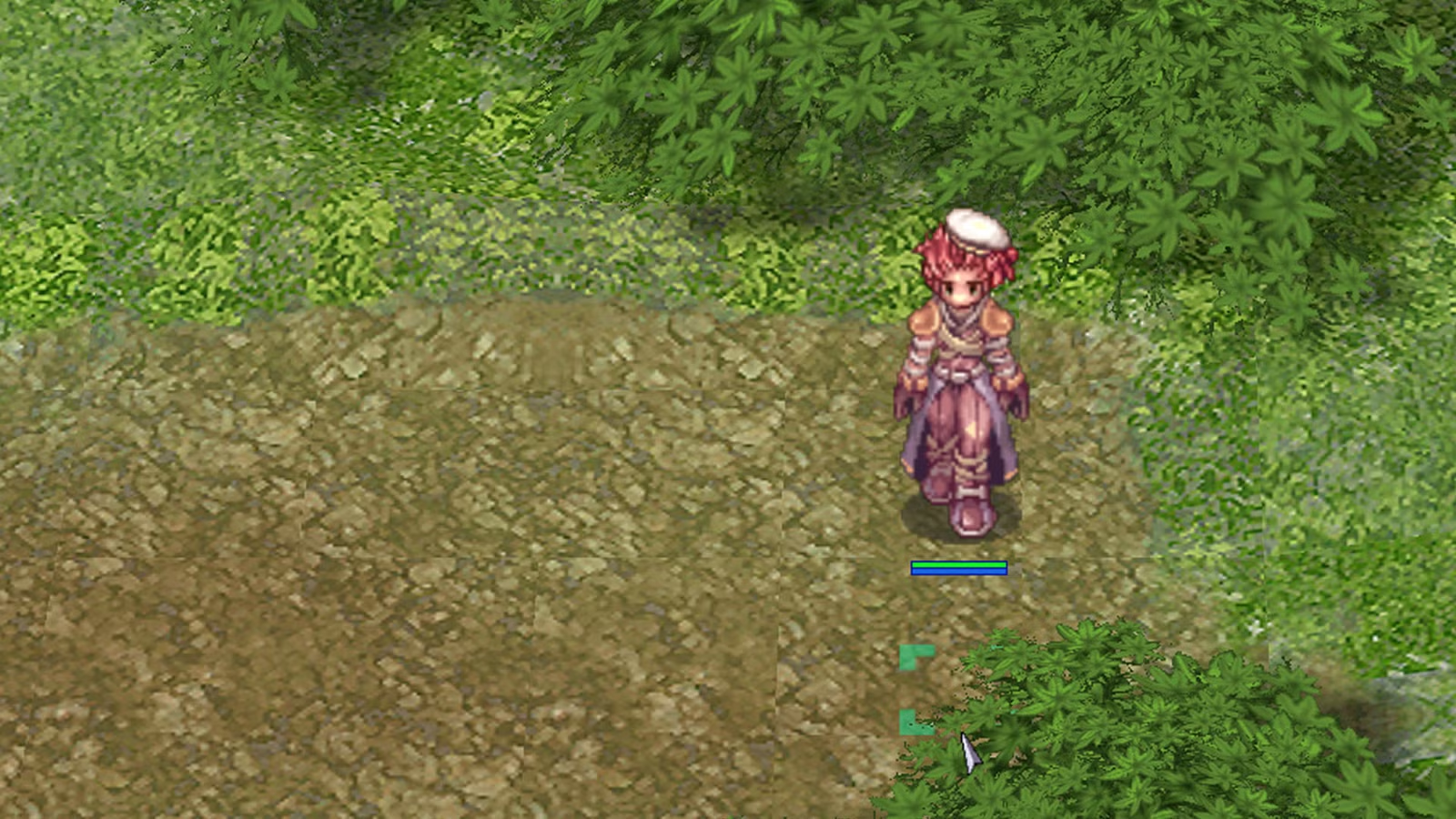
I created a character (a thief called Rhydioh) on the LATAM server, assuming it would have a higher population than the older servers. Playing a game, whether it is an old or a new one, for 30 days is not a sacrifice, but it requires commitment, one that was tested right in the first days of my experience. After spending four days leveling up my thief, I was taken aback by an unfortunate surprise. When I tried to log in, instead of seeing my red-haired male avatar, I was greeted by a message saying my account had been blocked. But I wasn’t going to let this situation stop me from diving deeper into Ragnarok‘s world, so I used another email address to create a new account. This time, it took only one day for my account to be blocked.
I wanted to keep up with my project, so I chose to create a third character, but this time on the old Brazilian server, where finally my thief flourished into a deadly level 79 assassin. As I logged in and started massacring every creature I could find, many aspects of the experience caught my attention. I understood how Ragnarok is a patchwork of multiple updates that weren’t integrated into a cohesive form. I realized that I miss playing an online game where I’m not pressured by hundreds of activities. However, above all else, what Ragnarok Online showed me is how lonely I have been feeling in modern online games. Amid the glut of live-service games of today, Ragnarok reminded me of a time when having a chance to play an online game meant an opportunity to legitimately connect with others.

Sure, one can argue that the modern gaming scene has been structured around the idea of connecting players. In League of Legends, you have text chat, while Valorant lets you get into voice chat with your team. Even live-service games mostly focused on the single-player experience, like Genshin Impact, still afford communication and some sort of interactivity between players. If an online game has none of these options, players can always rely on Discord or a console’s native voice chat system (which has also served as a tool to help the proliferation of “friendslop” games, havens for friends who want to do random stuff together).
Nevertheless, what all this infrastructure allows is socializing, not connection. Games and tools have been designed to facilitate players talking to each other and interacting in order to encourage them to play more, not to engage in a conversation. In 2011, MIT professor Sherry Turkle, in her book Alone Together, wrote that, because of technology, “a new style of being with each other becomes socially sanctioned.” She was pointing to the constitutive condition of online interactivity that puts us in a position of constant interaction, but never really connected.
While I also experienced goal-oriented interactions in Ragnarok Online, one cannot avoid having more sincere and unpretentious conversations while playing it. Unlike modern MMORPGS, Ragnarok forces you to stop and sit on the ground to recover health points. Depending on your level, it can take around 10 minutes before you’re ready to get back into action. While you can replenish your HP either by standing still or moving around, the recovery rate is 75% slower than while sitting. It is during these quite boring situations that the most sincere and memorable moments during this experience take place.
The first example that comes to mind was in front of the famous Payon Cave, one of the best places to level up a low-level character. As I was minding my own business, another player who was playing an acolyte class sat beside me. They asked if I was going to enter the cave and if I needed help. I thanked them for the offer, but I was about to log off after recovering my HP. Based on my recent experience in online games, as soon as you decline a group invitation, the other player leaves. However, the acolyte stayed and, instead of ignoring me, they started talking about their experience playing the game — the things they liked and the things they didn’t. I left after saying goodbye to them, with full HP and intrigued by what had just happened.

The next time, I was in Geffen, the city of mages. I had just attained my thief evolution and turned into the assassin class, but had died while trying to find a new place to level up. A few minutes after I sat down, a male character with edgy clothes and a shining aura stopped beside me. I said “hi,” and they responded with a simple “sup.” I asked what class they were playing in, and they told me it was the evolution of mine. When I thought the conversation wouldn’t go further than that, they decided to sit down. Next, we talked about how long they had been playing Ragnarok, and I learned that they were not interested in the endgame PvP content, called the War of Emperium, but preferred to just play with their friends and chill. After another few minutes, they stood up and said goodbye.
On those two occasions, I didn’t become friends with either of these players. Instead, I felt that I had an interaction in which two people decided to share their ideas without the expectation of endless engagement. Like when you exchange a word or two with a stranger sitting on the same bench while waiting for the next bus. It will arrive regardless of what both of you do, but why not take the opportunity and have a nice talk with the person beside you — an opportunity to share an experience together.