




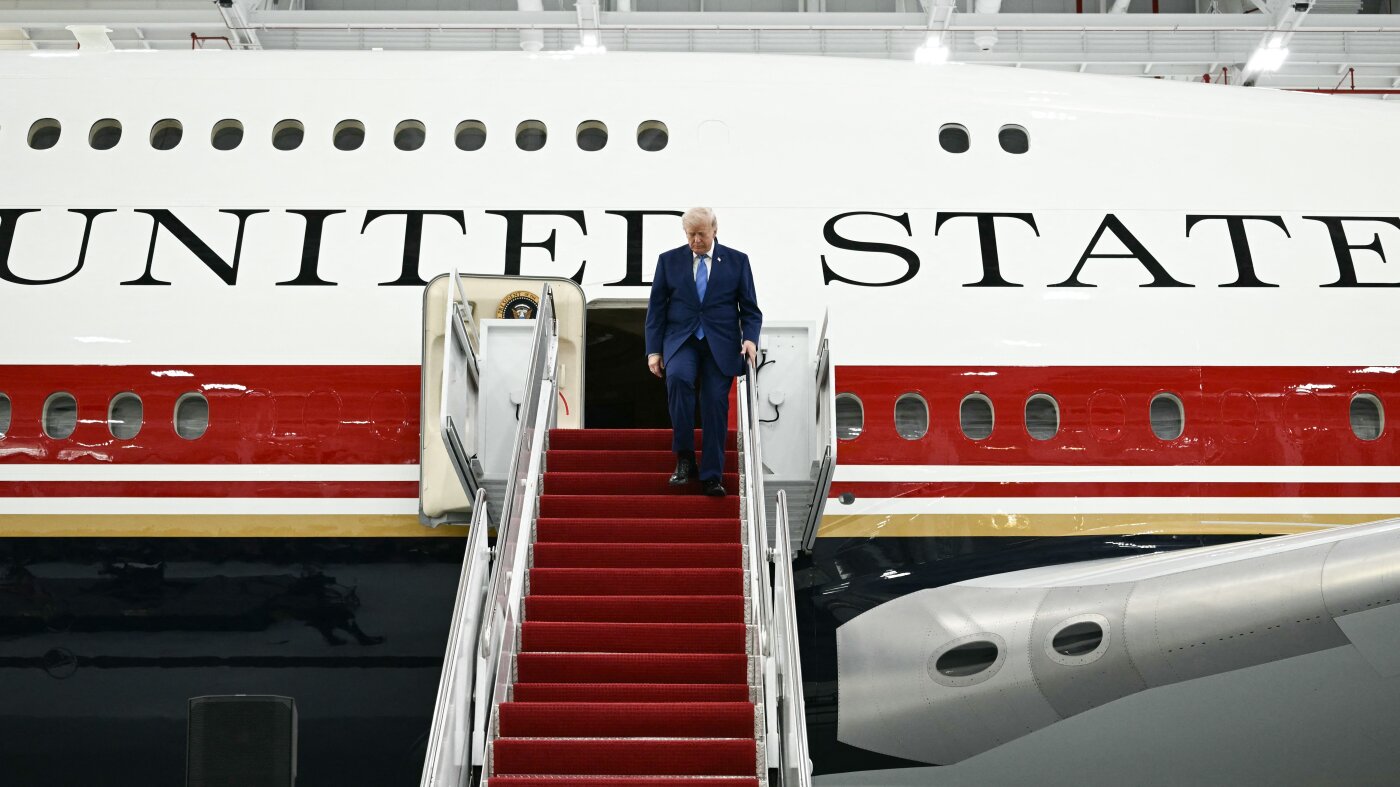

President Trump steps out of the new Air Force One, gifted to him by Qatar, in a hangar at Joint Base Andrews in Maryland in June. The New York Times reported earlier this month that security concerns had led the Secret Service to urge Trump to fly home from Turkey on a different jet.
BRENDAN SMIALOWSKI/AFP via Getty Images/AFP
hide caption
toggle caption
BRENDAN SMIALOWSKI/AFP via Getty Images/AFP
Stay up to date with our Up First newsletter sent every weekday morning.
The New York Times will argue in a federal court hearing Thursday that the White House is abusing the justice system to fish for its reporters’ sources in a story that outraged President Trump.
More broadly, the newspaper contends, the Trump administration is seeking to deter those same reporters from intense coverage of the president.
The offending stories, according to the Times, focused on security concerns surrounding the new luxurious Air Force One jet, a gift from the Qatari government.
“The Government’s actions violate the most basic First Amendment protections for newsgathering activity,” the Times legal team, led by David A. O’Neil of Debevoise & Plimpton, wrote in filings this week. “They represent the latest salvo in an escalating series of attacks on journalists to intimidate them from engaging in reporting that the Trump Administration openly detests.”
In recent years, including under Trump, it has been customary for the FBI to deliver subpoenas for reporters’ testimony and materials directly to news organizations so that their lawyers could fight them in court. Compelling evidence and testimony from reporters is supposed to be a last resort, not a first move, even under Trump’s then Attorney General Pam Bondi last year.
Agents instead went to several reporters’ homes on the night of Friday, July 10 — just two days after the first story was published — with subpoenas compelling their testimony before a grand jury. And the FBI pursued records involving all five reporters and several reporters’ family members, the paper said.
“When something like this happens, it’s very frightening,” says Katherine Marsh, the wife of Times reporter Julian E. Barnes. “You almost feel like you’re being treated as an enemy of the state and we’re just reporters and reporters’ families.”
‘Glaring indications of bad faith’
The paper pointed to its own subsequent reporting that FBI Director Kash Patel, while at the White House, personally oversaw the issuing of the subpoenas as proof that they were motivated by considerations of the administration’s wishes. His orchestration of the day’s events would represent an extraordinary involvement of a presidentially appointed law enforcement official just yards from the Oval Office.
“The record is replete with glaring indications of bad faith,” the Times” lawyers write in their filings.
The paper is seeking to convince U.S. District Court Judge Arun Subramanian to quash the subpoenas at the hearing, which will be in a Manhattan federal courthouse.
For its part, the U.S. Justice Department has insisted it has acted properly in pursuit of preserving national security. Officials have said they are seeking the source of a national security breach, not trying to interfere with the newspaper’s reporting. (The Justice Department, the FBI, the White House and the Department of Homeland Security have not commented in response to NPR’s questions.)
In Senate testimony last week, U.S. Attorney Jay Clayton, the chief federal prosecutor for the Southern District of New York, said he had followed all appropriate policies.
The Justice Department had sought to “limit to the greatest extent possible any intrusion into the operation of the free press,” Clayton said. “I’m absolutely committed to and respect our First Amendment and the role of the press.”
Trump has nominated Clayton to be the next director of national intelligence.
New York Times says FBI pursued family members’ phone records
In recently unsealed documents, the Times legal team argues that the Justice Department has violated its own policies to pursue subpoenas from reporters as a last resort.
In addition, the Times said in legal documents, the FBI sought the phone records from telephone providers for five reporters, the spouses of two reporters and mother of one of them without initially disclosing this to the Times, making it initially impossible to seek a court to intercede.
Times Reporter Barnes was watching the new movie The Sheep Detectives with his elder son and Marsh when agents arrived that Friday. The Times has declined to make reporters available for comment.
But Marsh tells NPR the FBI’s visit was not just disruptive but unsettling.
Marsh, a former reporter turned author, later learned that the government was seeking her phone records as well.
“If one were to look at my phone records, I do a lot of eldercare… [for] my parents,” Marsh says. “So there’s a lot of calls about that. There are my two teenagers, and there’s my career as a book author. So there’s nothing relevant at all to the larger case at hand.”
“That’s why it was very creepy for this to happen,” Marsh says.
Marsh points to her 2023 novel The Lost Year about Soviet dictator Josef Stalin’s iron-fisted rule over Ukraine in the 1930s, which led to the deaths of millions there.
“I have scenes of government agents showing up at the door, of press freedom getting suppressed, and family members getting tainted by association,” Marsh says. “So to me this felt really un-American.”
There are both historical overtones and immediate implications to the Trump administration’s current battle with the press. The Times has, in particular, emerged as a public combatant on behalf of independent journalism, a cause publicly embraced in the Trump era by Publisher A.G. Sulzberger.
Trump personally sued the Times last year for $15 billion over its coverage of his past business failings. The newspaper called it “intimidation tactics.” (Trump has also sued several major television news division and networks as well as newspapers from the Wall Street Journal to the Des Moines Register.)
For its part, The Times has sued the Trump administration over the Pentagon’s new restrictions on the press. Regime Change, the recent runaway bestseller by Times reporters Maggie Haberman and Jonathan Swan, has vexed the president further.
All about that plane
When Qatar gave the Boeing 747, fit for an Emirate prince, to Trump last year, some observers voiced concerns, both on grounds of security and propriety. Trump has praised the plane lavishly and indicated he wants it to go to his presidential foundation once he leaves the White House.
On July 8, however, citing unnamed sources, the Times reported he had traveled home from a NATO summit in Turkey on an older version of Air Force One due to security concerns of the Secret Service. It was the first time the president was traveling so close to Iran since the outbreak of the U.S. and Israeli war with that nation.
A subsequent story the next day detailed several specific concerns, some of which arose from observations made by analysts looking at the plane’s exterior from afar.
Since the New York Times reporting on Air Force One, Trump has denied and then downplayed any security concerns. Even so, earlier this week, Trump said the plane would be taken off duty and “maxed out,” seemingly validating the idea that it needed to be upgraded further for presidential security.
A memo submitted on Tuesday by Clayton and his chief counsel declared that the Times had offered the court an incorrect recitation of events. In particular, the prosecutors asserted that the government’s basis for seeking the subpoenas was sound.
That said, Clayton’s memo acknowledged that the government had only informed the Times‘ legal team of the subpoenas for the phone records days after they had been issued with “non-disclosure” orders to the phone service providers.
“[I]n light of additional case law that the Government identified after the issuance of the subpoenas,” the memo states, “the Government determined on July 17 that it was appropriate to alert counsel to those subpoenas so that counsel could advance any arguments – regardless of merit – in furtherance of their motions.”
The brief did not set out why the government was unaware of such legal precedents before issuing the subpoenas and deciding how to handle them.