





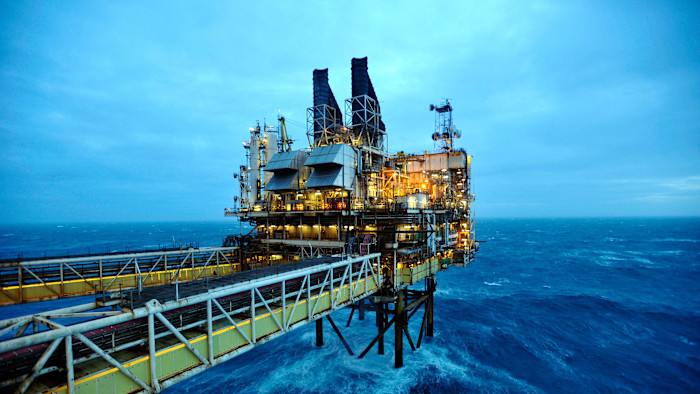
A rush among European and Asian refineries to secure oil cargoes has pushed North Sea prices to a record high as Iran’s stranglehold on the Strait of Hormuz triggers fresh angst in the market.
Forties Blend, a marker for oil for immediate delivery, hit almost $147 a barrel on Thursday, above the highs reached on the eve of the 2008 financial crisis as traders scrap for oil cargoes to replace huge volumes now trapped in the Gulf, according to LSEG data.
The physical barrels from the North Sea were trading far above the roughly $97 price of Brent, the international benchmark, for delivery in June — another sign of fear of shortages in the oil market.
The rush to secure cargoes was so intense it disrupted a vital pillar of the oil market. Traders said they were unable to buy Brent contracts for difference — which track the gap in prices between barrels for immediate delivery and for future delivery — for next week after the prices for the CFDs exceeded $30 a barrel, breaching the Intercontinental Exchange’s threshold. ICE is the main bourse for European oil trading.
These contracts are widely used to hedge against rises in oil prices. Several market participants said they could not remember a time when they were unable to trade Brent contracts for difference and noted that some dealing was now taking place outside of the exchange.
ICE did not respond to requests for comment.

The mounting signs of stress highlight how the global energy crisis is worsening despite assurances from US President Donald Trump that Tehran would soon open the strait, which before the US and Israel’s Iran war transported 20 per cent of global oil supplies.
Trump on Thursday said “very quickly, you’ll see oil start flowing”.
But he also said Iran was “doing a very poor job” of allowing oil shipments to transit through the strait, warning Tehran had “better not be” charging tolls for safe passage.
Only a handful of ships, most of them connected to Iran, have passed through the strait since the two-week ceasefire was announced on Tuesday.
Oil exports via the strait have fallen in recent days and are running at only 8 per cent of the normal level, Goldman Sachs told clients on Thursday.
Asia is especially vulnerable to disruption because about 80 per cent of oil and petroleum products it needs transit the waterway.
Tehran has insisted the pact with the US will allow it to maintain control over the strait, requiring vessels to seek permission from Iran’s Revolutionary Guards and pay a fee. Within hours of the deal to pause fighting, it halted the passage of oil tankers through the strait in response to Israeli strikes on Lebanon.
Amos Hochstein, who was an energy adviser to former president Joe Biden, said: “If this continues for a few more days, we can see the market deciding that the straits are closed indefinitely, which could lead not only to an increase in price but to a crisis in Asia.”
“This is not just about high prices. This is about an actual physical shortage, which is playing out.”
In a further sign of the tightness in markets, Saudi Arabia on Thursday said its oil production capacity had fallen by 600,000 barrels a day because of recent attacks on its energy infrastructure.
The strikes have damaged production capacity at the Khurais and Manifa fields, knocking out about 5 per cent of the kingdom’s normal 12mn b/d capacity. The energy ministry said this week’s attack on the East-West pipeline, a critical route for avoiding the Strait of Hormuz, also caused a loss of about 700,000 b/d in throughput.
Dennis Kissler, senior vice-president at the trading division of BOK Financial, warned tight supplies “in the physical market are going to stay like that till we get ships moving through the Strait of Hormuz”.
He added: “You will see the futures market sell off but the physical market will stay tight because it will take 20 days to correct the logistical problems even when the strait opens.”
Dated Brent, a closely tracked measure of the price of physical oil shipments bought and sold in the North Sea that includes Forties Blend, rose 7 per cent on Thursday to $131.96, according to an assessment by pricing agency Platts, retracing some of a fall the previous day prompted by the ceasefire deal.
In early trading on Friday, the price of Forties Blend slipped to $140 a barrel.
Trading activity was tamer in the futures market. Brent for June delivery rose 0.8 per cent on Friday to $96.71, while US benchmark West Texas Intermediate was up 0.4 per cent at $90.33.
Helima Croft, head of global commodity strategy at RBC Capital Markets, called the prices in futures markets a “lagging indicator for the physical market realities of Middle Eastern waterways”.
Iran had yet to begin direct talks with the US despite the two-week ceasefire agreed this week, Iran’s foreign minister Abbas Araghchi told his Saudi Arabian counterpart, Prince Faisal bin Farhan, in a phone call on Thursday, according to an Iranian readout.
Trump is dispatching a delegation led by vice-president JD Vance, special envoy Steve Witkoff and the president’s son-in-law Jared Kushner to Islamabad for talks this weekend.
Additional reporting by Ahmed Al Omran in Jeddah